Valparaiso to Puerto Williams
available
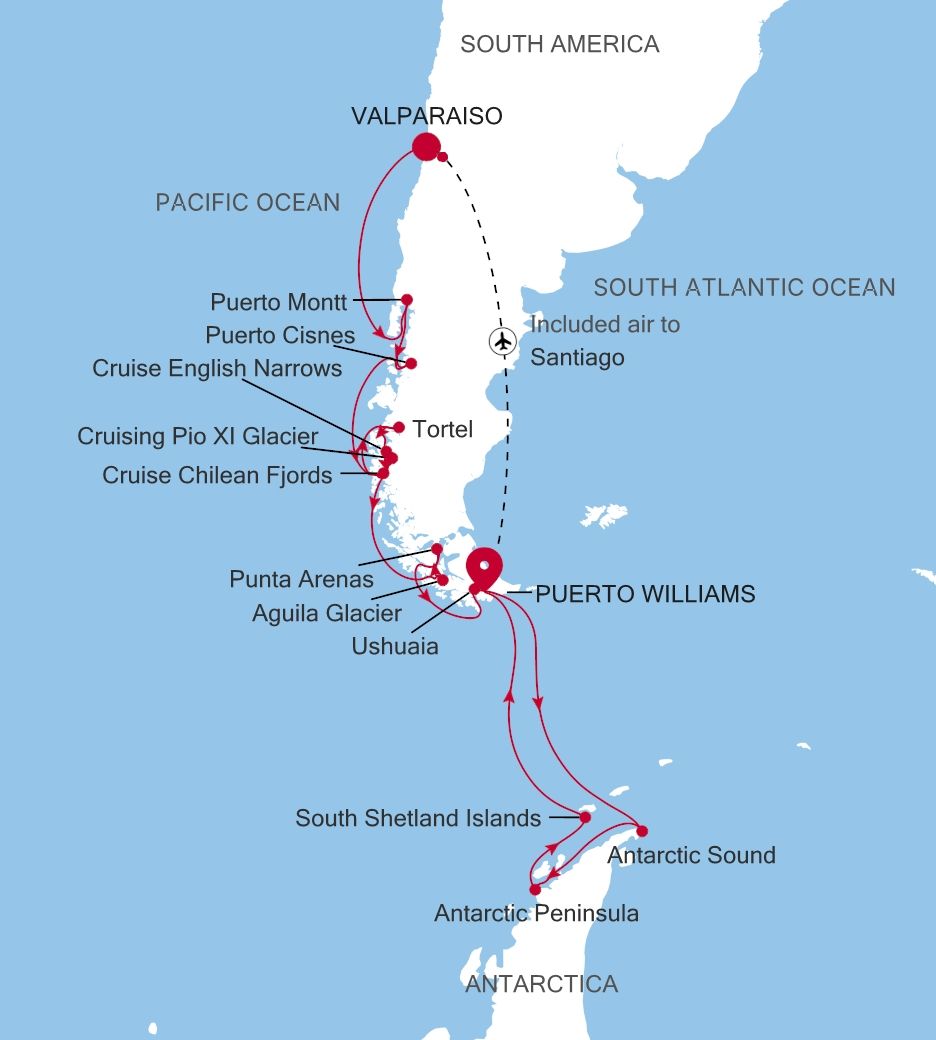
Route
Day by day
Day 1 — Valparaiso
Day 2 — Day at sea
Days at sea are the perfect opportunity to relax unwind and catch up with what you’ve been meaning to do. So whether that is going to the gym, visiting the spa, whale watching, catching up on your reading or simply topping up your tan these blue sea days are the perfect balance to busy days spent exploring shore side.
Day 3 — Puerto Montt
For most of its history, windy Puerto Montt was the end of the line for just about everyone traveling in the Lake District. Now the Carretera Austral carries on southward, but for all intents and purposes Puerto Montt remains the region's last significant outpost, a provincial city that is the hub of local fishing, textile, and tourist activity.Today the city center is full of malls, condos, and office towers—it's the fastest-growing city in Chile—but away from downtown, Puerto Montt consists mainly of low clapboard houses perched above its bay, the Seno de Reloncaví. If it's a sunny day, head east to Playa Pelluco or one of the city's other beaches. If you're more interested in exploring the countryside, drive along the shore for a good view of the surrounding hills.
Day 4 — Puerto Cisnes
Day 5 — Cruise Chilean Fjords
Strewn through the coast of Chile, these beautiful fjords are world renowned for being one of the most awe-inspiring places on earth. Snow-capped volcanoes nestle majestically alongside rolling valleys of ice and frosty glaciers. Rugged beauty, breathtaking scenery not to mention diverse and profuse wildlife abounds – expect to watch whales from the deck, see playful Magellan Penguins and perhaps even spot the rare Andean Condor. Affectionately named “The End of the World” by the Spaniards who discovered the region in eighteenth century in a quest to Christianise South America, these extraordinary waterways not only encompass a medley of jagged mountains and iceberg strewn bays, but feature a kaleidoscopic spectrum of unexpected colour that offers photographic opportunities like no other destination.
Day 6 — Tortel
Tortel is a commune located in Southern Patagonia a spectacular wilderness region of rugged mountains glaciers rivers and forests of infinite beauty. The uneven geography of Tortel shapes a unique landscape characterized by an archipelagic area with numerous islands and channels. Tortel is known as the “footbridge city” for the unique beauty of its wooden walkways that connect the piers and houses of this quaint place through bridges and stairs built from cypress wood that run for four and a half miles around the cove and that respect the rich vegetation that grows under them. Even though it is the sixth largest commune in Chile it has the lowest population of all with roughly 531 people. The history of the town dates back to 1520 when it was inhabited by nomadic Kawesqar now extinct. Its definitive foundation was in 1955 after numerous attempts to populate the area. In 2001 it was declared by the Chilean government as a Picturesque Zone of National Heritage.
Day 7 — Cruise English Narrows
English Narrows refers to a narrow passage at the southern end of the Messier Channel in Chile’s Region XI, Aysen del General Carlos Ibanez del Campos. The region is Chile’s least populated and a few kilometers south of English Narrows is Puerto Eden, the only settlement along the entire Chilean Inside Passage. With Wellington Island to the west and surrounded by Chile’s largest national park, Bernardo O’Higgins National Park, the narrow passage is at times 180 meters wide, while the entire length is given as 18 kilometers. Low-lying islands and steep mountains are seen on both sides and the Magellanic subpolar forest with its evergreen trees of the genus Nothofagus has taken hold where possible. The strong currents require to pass English Narrows at slack tide and although most of the Messier Channel leading to English Narrows is quite deep, a shipwreck sitting on a bank some 20 kilometers north of the entrance to English Narrows shows why pilots are required by law in Chile.
Day 7 — Cruising Pio XI Glacier
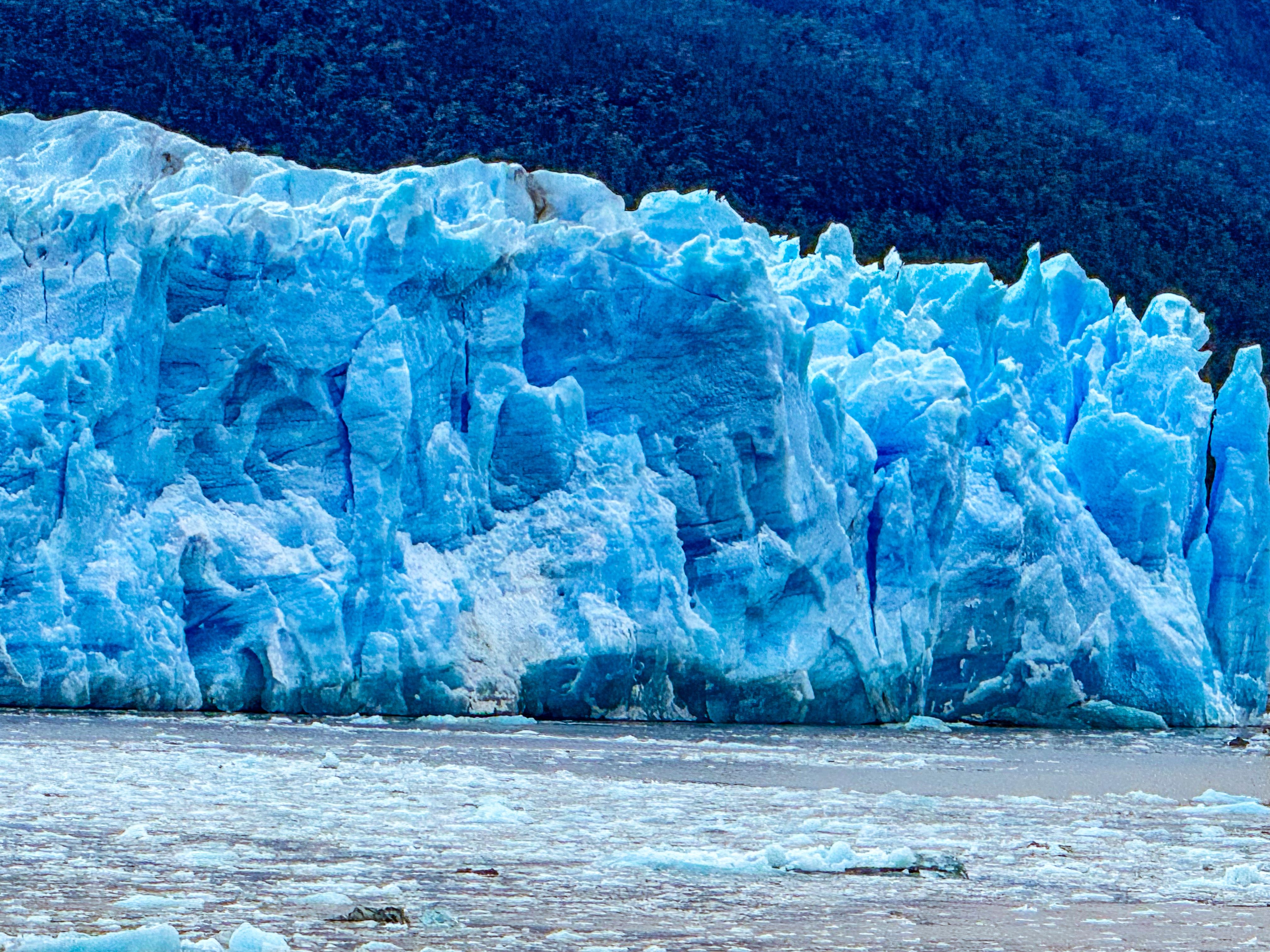
Within Bernardo O’Higgins National Park the Pio XI Glacier (also known as Brüggen Glacier after the German geologist Johannes Brüggen) is found at the terminus of the 23 nautical miles long Eyre Fjord, one of the fjords coming from the northeast and the Southern Patagonian Ice Field. The fjord and its shores were formerly used by the nomadic Kaweskar to hunt, while the glacier was one of their sacred sites. Pio XI Glacier is the largest western outflow of the Southern Patagonian Ice Field and is South America’s longest glacier and the largest in the Southern Hemisphere outside of Antarctica. One of the few advancing glaciers, its front has a width of 4.5 kilometers, a height of approximately 80 meters and shows several central moraines, indicating that Greve Glacier and Occidental Glacier to the north once joined the glacial tongue. Approaching the glacier by ship and by Zodiac safe distances will be maintained, as the glacier shows extensive mudflats on its southeastern side leading to Exmouth Fjord and calvings can always occur. The rocky shore shows signs of Nothofagus trees and the temperate Magellanic rain forest where the extremely rare and endangered South Andean deer, locally known as the huemul, has been sighted. Chilean and Peale’s dolphins and the endangered southern river otters have been recorded, and South American sea lions can be seen. Among the birds expected are Imperial Shags, South American Terns, Brown-hooded Gulls, Kelp Gulls, Kelp Geese, and Fuegian Steamer Ducks.
Day 8 — Cruise Chilean Fjords
Strewn through the coast of Chile, these beautiful fjords are world renowned for being one of the most awe-inspiring places on earth. Snow-capped volcanoes nestle majestically alongside rolling valleys of ice and frosty glaciers. Rugged beauty, breathtaking scenery not to mention diverse and profuse wildlife abounds – expect to watch whales from the deck, see playful Magellan Penguins and perhaps even spot the rare Andean Condor. Affectionately named “The End of the World” by the Spaniards who discovered the region in eighteenth century in a quest to Christianise South America, these extraordinary waterways not only encompass a medley of jagged mountains and iceberg strewn bays, but feature a kaleidoscopic spectrum of unexpected colour that offers photographic opportunities like no other destination.
Day 9 — Aguila Glacier
Day 10 — Punta Arenas
Welcome to Chile's City at the End of The World – a wind-whipped, fractured land of islands, glacial fjords and mountains, which drop away towards Antarctica. A hardy city, where the temperature hovers in single figures throughout much of the year, Punta Arenas nevertheless offers a warm welcome and refuge, ahead of - and following - epic adventures and expeditions south across the Drake Passage. Captain Scott stopped here in 1904 – testing the postal service sending 400 letters of his successful return - and the city welcomed the rescued Ernest Shackleton and his Endurance crew to these shores in 1916. Punta Arenas is a remote place, but with custom-free status, and more than 120,000 people calling it home it's also surprisingly cosmopolitan. The commercial centre of Magallanes Punta Arenas is fueled by Chilean oil and gas - and establishing itself as a global centre for Antarctic research, with teams from various countries basing themselves here. The town is built around the Plaza de Armas, its central square - be sure to kiss the toe of the Monumento del Indio Patagon statue, said to guarantee you good luck on your return. Look down across this colourful city, stretching out to meet the waters of the Straits of Magellan, from the viewpoint at Cerro De La Cruz. Natural wonders abound in the region, whether it’s Alberto de Agostini National Park’s glacial sculptures, or Torres del Paine National Park’s soaring mountains, rushing waterfalls and picturesque lakes. Offshore, in the Strait of Magellan, you can find the birdlife sanctuary of Magdalena Island - an uninhabited island, where hundreds of thousands of penguins march and crowds of cormorants and gulls call out.
Day 11 — Ushuaia
A southerly frontier - on the cusp of wild nature and extraordinary adventures - the excitement in Ushuaia is palpable. Prepare for memorable exploits amid the extremes of this southerly location - as you adventure into the colossal scenery of the fractured Tierra del Fuego and beyond. Known as the 'End of the World' Ushuaia looks out across the Beagle Channel, and is surrounded by the Martial Mountains to the north. Despite its remote location, Ushuaia is a surprisingly busy and lively resort, with lots to keep its visitors entertained. For many people, Ushuaia is their last glimpse of anything resembling a city, before they jump off the map into the wilderness, to answer the call of immense national parks or Antarctic expeditions. One of the most dramatic landscapes on the planet - Argentina's land of fire, National Park Tierra del Fuego, is a place of titanic natural forces and limitless beauty. Snow-covered mountains poke the sky, while glaciers spill down between peaks, and gaping fjords open up. With incredible wildlife - from penguins to whales - the park offers some of South America's most amazing hiking opportunities and panoramas. When it comes to food in Ushuaia, locals cook up fierce flavours using the freshest ingredients. King crab is one of the most popular dishes, while sea bass - hauled freshly from the waters - and mounds of meaty mussels - known as cholgas - are also on the menu here.
Day 12 — Drake Passage
Sailing the legendary Drake Passage is an experience that few are ever lucky enough to experience. The southern tip of the Americas already feels like a wild enough environment – but the sensation of watching the distant cliffs of the peninsular known as the ‘End of the World’ fade into the horizon, is one that’s equal parts epic, eerie and magical. Set sail, to slowly drop off the bottom of the map from Cape Horn, and voyage on an expedition down into the icy underworld of Antarctica. Drake Passage is an extraordinary voyage of romantic ocean faring legend, as you aim for Antarctica’s icy realm. On arrival, skyscraper sized icebergs salute you, as you traverse the waters of this continent where snow and ice dwelling creatures like penguins and whales roam undisturbed. Your first sight of this most-unexplored place will most likely be the South Shetland Islands. Walk in the footsteps of some of history’s greatest and bravest explorers as you explore famed, snow-covered landmasses like Elephant and Deception Island. If the journey across Drake Passage sounds daunting, don’t worry – even in rough seas you’re never alone, and will often be accompanied on this spine-tingling adventure by soaring albatrosses and maybe even a protective pod of humpbacks and hourglass dolphins or two. Converging warm and cool ocean currents attract some spectacular animal life to the passage.
Day 13 — Drake Passage
Sailing the legendary Drake Passage is an experience that few are ever lucky enough to experience. The southern tip of the Americas already feels like a wild enough environment – but the sensation of watching the distant cliffs of the peninsular known as the ‘End of the World’ fade into the horizon, is one that’s equal parts epic, eerie and magical. Set sail, to slowly drop off the bottom of the map from Cape Horn, and voyage on an expedition down into the icy underworld of Antarctica. Drake Passage is an extraordinary voyage of romantic ocean faring legend, as you aim for Antarctica’s icy realm. On arrival, skyscraper sized icebergs salute you, as you traverse the waters of this continent where snow and ice dwelling creatures like penguins and whales roam undisturbed. Your first sight of this most-unexplored place will most likely be the South Shetland Islands. Walk in the footsteps of some of history’s greatest and bravest explorers as you explore famed, snow-covered landmasses like Elephant and Deception Island. If the journey across Drake Passage sounds daunting, don’t worry – even in rough seas you’re never alone, and will often be accompanied on this spine-tingling adventure by soaring albatrosses and maybe even a protective pod of humpbacks and hourglass dolphins or two. Converging warm and cool ocean currents attract some spectacular animal life to the passage.
Day 14 — Antarctic Sound
Few voyages ignite the imagination like a journey down to one of the planet’s most remote extreme and enchanting wilderness Antarctica. An adventure in its purest form only a handful of people will ever be lucky enough to experience the majestic beauty of these monochrome landscapes first-hand. The Antarctic Sound will be one of your first encounters of this whitewash kingdom located at the northerly tip of the Antarctic Peninsula - which sprawls up like a tentacle towards Tierra del Fuego, South America’s most southerly point, otherwise known as the ‘End of the World’. Taking its name from the first ship to brave the passageway between the peninsula and the Joinville Island groups back in 1902, the Sound is a raw sensory assault of imposing iceberg slabs broken away from the disintegrating Larsen Ice Shelf. Come face-to-face with stadium-sized islands of ice and meet the extraordinary birdlife that call this whitewash kingdom home. Watch on as colonies of Gentoo penguins hop around and cape petrels sweep overhead as the continent’s unique wildlife thrives around you. If you’re planning your first venture into Antarctica you’ll want to brush up on your photography skills in advance to capture this unforgiving continent in all of its unrestrained glory.
Day 15 — Antarctic Peninsula
The Antarctic Peninsula unravels upwards towards South America reaching out a beckoning finger to the adventurous who dare to explore this untamed realm. Stretching up from the heart of the world’s southernmost continent the Antarctic Peninsula lies a mere 620 mile from Tierra del Fuego and for many offers a spectacular first taste of the snow-blanketed landscapes and colossal ice sculptures which make up Earth’s least-explored continent. Unseen by humans until 1820 - a blink of an eye ago in relative terms - this is an adventure sure to make your hairs stand on end as you experience the thrill of the truly unknown and extraordinary. The vast peninsula is sprinkled with research bases which are at the frontline of human scientific endeavour pushing to study and understand this unique landscape, its exceptional wildlife and the impact that humans are having on this pristine continent. Witness cathedral-sized icebergs up close and blue-hued glaciers slowly slipping from imposing locations.
Day 16 — Antarctic Peninsula
The Antarctic Peninsula unravels upwards towards South America reaching out a beckoning finger to the adventurous who dare to explore this untamed realm. Stretching up from the heart of the world’s southernmost continent the Antarctic Peninsula lies a mere 620 mile from Tierra del Fuego and for many offers a spectacular first taste of the snow-blanketed landscapes and colossal ice sculptures which make up Earth’s least-explored continent. Unseen by humans until 1820 - a blink of an eye ago in relative terms - this is an adventure sure to make your hairs stand on end as you experience the thrill of the truly unknown and extraordinary. The vast peninsula is sprinkled with research bases which are at the frontline of human scientific endeavour pushing to study and understand this unique landscape, its exceptional wildlife and the impact that humans are having on this pristine continent. Witness cathedral-sized icebergs up close and blue-hued glaciers slowly slipping from imposing locations.
Day 17 — Antarctic Peninsula
The Antarctic Peninsula unravels upwards towards South America reaching out a beckoning finger to the adventurous who dare to explore this untamed realm. Stretching up from the heart of the world’s southernmost continent the Antarctic Peninsula lies a mere 620 mile from Tierra del Fuego and for many offers a spectacular first taste of the snow-blanketed landscapes and colossal ice sculptures which make up Earth’s least-explored continent. Unseen by humans until 1820 - a blink of an eye ago in relative terms - this is an adventure sure to make your hairs stand on end as you experience the thrill of the truly unknown and extraordinary. The vast peninsula is sprinkled with research bases which are at the frontline of human scientific endeavour pushing to study and understand this unique landscape, its exceptional wildlife and the impact that humans are having on this pristine continent. Witness cathedral-sized icebergs up close and blue-hued glaciers slowly slipping from imposing locations.
Day 18 — South Shetland Islands
The ice-coated Antarctic Peninsula forms perhaps the most accessible region of mainland Antarctica lying a mere 480-miles away from South America across the fabled waters of Drakes Passage. Lying close to the northwestern tip of the Antarctic Peninsula separated by the Bransfield Strait, the South Shetland Islands fall under the jurisdiction of the Antarctic Treaty, suspending claims on their sovereignty. Several countries maintain research bases here and with plump elephant seals and crowds of Gentoo, Chinstrap, and Adelie Penguins also calling the islands home it can even feel a little crowded at times. King George Island is the largest and most hospitable island hosting the majority of the research stations - some of which are populated all-year-round by tiny hardy crews. Don’t be fooled though these islands offer extraordinary adventure in one of the most remote locations on earth. The triple peaks of Mount Foster tower above the archipelago. Hike the luna landscapes within and even dip into the improbably warm geothermally-heated waters of Pendulum Cove. Elephant Island meanwhile is written deep into the annals of Antarctic expedition legend as the site where Ernest Shackleton and the stricken crew of the Endurance miraculously survived a harsh Antarctic winter in 1916.
Day 19 — Drake Passage
Sailing the legendary Drake Passage is an experience that few are ever lucky enough to experience. The southern tip of the Americas already feels like a wild enough environment – but the sensation of watching the distant cliffs of the peninsular known as the ‘End of the World’ fade into the horizon, is one that’s equal parts epic, eerie and magical. Set sail, to slowly drop off the bottom of the map from Cape Horn, and voyage on an expedition down into the icy underworld of Antarctica. Drake Passage is an extraordinary voyage of romantic ocean faring legend, as you aim for Antarctica’s icy realm. On arrival, skyscraper sized icebergs salute you, as you traverse the waters of this continent where snow and ice dwelling creatures like penguins and whales roam undisturbed. Your first sight of this most-unexplored place will most likely be the South Shetland Islands. Walk in the footsteps of some of history’s greatest and bravest explorers as you explore famed, snow-covered landmasses like Elephant and Deception Island. If the journey across Drake Passage sounds daunting, don’t worry – even in rough seas you’re never alone, and will often be accompanied on this spine-tingling adventure by soaring albatrosses and maybe even a protective pod of humpbacks and hourglass dolphins or two. Converging warm and cool ocean currents attract some spectacular animal life to the passage.
Day 20 — Puerto Williams
Puerto Williams is a Chilean city located on Navarino Island on the southern shores of the Beagle Channel. It claims to be the “southernmost city in the world”, however owing to its small size – 2500 residents approximately – the much larger Argentinean city of Ushuaia, which sits on the northern side of the same channel, also claims that title. The surrounding scenery is magnificent. The wild windswept mountains rise above the tree line and are regularly dusted with snow. The city itself has the dramatic backdrop called “Dientes de Navarino” (literally “teeth of Navarino”), which rival the famous Torres del Paine further to the north. The area was originally used by the Yaghan people, hunter-gatherers who despite enduring the harsh regional climate, could not weather the arrival of Europeans. The current city was established as a naval base in 1953 and honours the British-Chilean naval commander John Williams Wilson of the 16th century. Initially it served to protect territorial possessions and fishing rights of the area, as well as offering logistical support to Antarctic bases. More recently it has become a departure point for scientific and tourism trips to the Antarctic region. In contrast to the bustle and traffic of a very commercial Ushuaia, Puerto Williams offers a quieter, more relaxed experience. It charms the visitor with a small village feel, complete with rustic buildings and the homely smell of drifting wood smoke. A haven of peace at the end of the world.
Day 21 — Puerto Williams
Puerto Williams is a Chilean city located on Navarino Island on the southern shores of the Beagle Channel. It claims to be the “southernmost city in the world”, however owing to its small size – 2500 residents approximately – the much larger Argentinean city of Ushuaia, which sits on the northern side of the same channel, also claims that title. The surrounding scenery is magnificent. The wild windswept mountains rise above the tree line and are regularly dusted with snow. The city itself has the dramatic backdrop called “Dientes de Navarino” (literally “teeth of Navarino”), which rival the famous Torres del Paine further to the north. The area was originally used by the Yaghan people, hunter-gatherers who despite enduring the harsh regional climate, could not weather the arrival of Europeans. The current city was established as a naval base in 1953 and honours the British-Chilean naval commander John Williams Wilson of the 16th century. Initially it served to protect territorial possessions and fishing rights of the area, as well as offering logistical support to Antarctic bases. More recently it has become a departure point for scientific and tourism trips to the Antarctic region. In contrast to the bustle and traffic of a very commercial Ushuaia, Puerto Williams offers a quieter, more relaxed experience. It charms the visitor with a small village feel, complete with rustic buildings and the homely smell of drifting wood smoke. A haven of peace at the end of the world.
Cabin offers
| Cabin | Occupancy | Price (per person) | Promo | Availability | Source | |
|---|---|---|---|---|---|---|
| Veranda SuiteBest price | double | $31,500 | Save 10% | available | Silversea Cruises | View at operator |
| Medallion Suite | double | $42,210 | Save 10% | available | Silversea Cruises | View at operator |
| Silver Suite | double | $43,110 | Save 10% | available | Silversea Cruises | View at operator |
| Royal Suite | double | $45,810 | Save 10% | available | Silversea Cruises | View at operator |
| Grand Suite | double | $49,410 | Save 10% | available | Silversea Cruises | View at operator |
| Owner’s Suite | double | $53,010 | Save 10% | available | Silversea Cruises | View at operator |
| Deluxe Veranda Suite | double | — | — | sold out | Silversea Cruises | |
| Vista Suite | double | — | — | sold out | Silversea Cruises |
Prices are captured from operator websites and may change — the operator's site is authoritative. Captured Jul 3, 2026 06:50 UTC.