| Scientific name | Spheniscus magellanicus |
|---|---|
| Conservation status | LC Least Concern |
| Standing height | 61–76 cm |
| Weight | 2.7–6.5 kg |
| Primary diet | Fuegian sprat, anchovy, hake, squid & krill |
| Diving & swimming | To 95 m · faithful to the same burrow for decades |
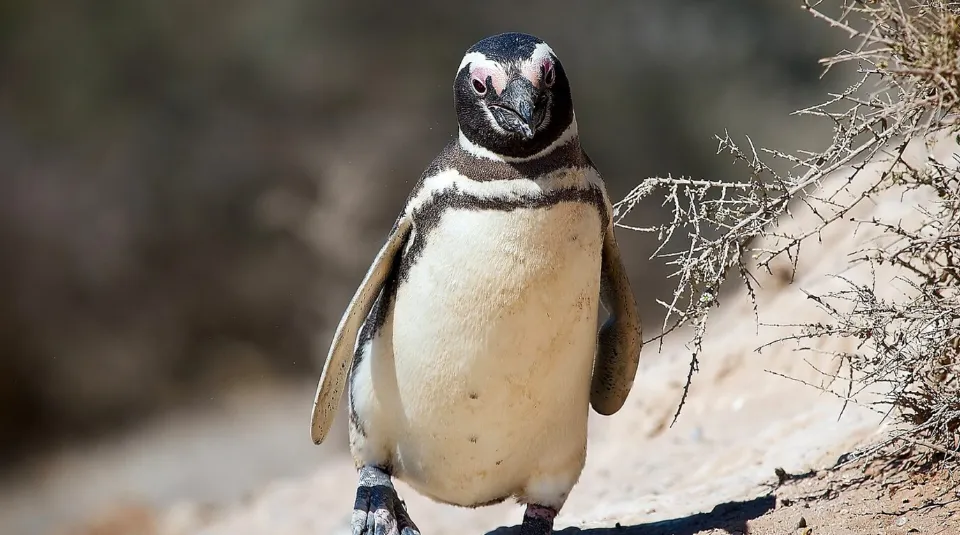
| Did you know? | When summer sun warms Falkland and Patagonian burrows, Magellanic penguins flush blood into bare pink skin arches around their eyes and pant rapidly to shed excess body heat. |
Most travellers meet the Magellanic penguin well before the ice, on the approach legs through Falkland Islands and Patagonia, where dense burrow colonies line the coastal scrub. Further south, smaller groups turn up on islets scattered through the Beagle Channel and along the shores of Tierra del Fuego, often loafing on rocks near landing sites rather than in large rookeries.
It is the most numerous of the banded, or Spheniscus, penguins — a family that also includes the African, Humboldt, and Galápagos penguins, its closest relatives. The species takes its common name from Ferdinand Magellan, whose expedition recorded the birds along this coast in 1520, and it remains listed as Least Concern, with breeding populations spread across Argentina, Chile, and the Falklands.
Not every bird stays put: some Magellanic penguins migrate north after the breeding season as far as Brazil and Uruguay, occasionally straggling up to Espírito Santo, so numbers along these shores thin out later in the year. For expedition passengers, the practical window is the austral spring and summer, when the colonies are at their busiest and the birds are easiest to watch from a safe distance on land.
When to Spot Magellanic Penguin (Oct–Mar)
Colonies build stone nests in November, hatch chicks across December–January, and fledge crèches into coastal waters during February.
Frequently asked questions about Magellanic Penguin
Browse all Antarctica expedition FAQsWhen is the best time to see Magellanic Penguin in Antarctica?
Peak sighting months for Magellanic Penguin are November, December, January. Colonies build stone nests in November, hatch chicks across December–January, and fledge crèches into coastal waters during February. See our penguin chick hatching calendar and Early vs Peak vs Late Summer guide.
Where can you spot Magellanic Penguin on an Antarctica cruise?
Magellanic Penguin (Spheniscus magellanicus) is primarily encountered in Beagle Channel, Tierra del Fuego, Patagonia, Cape Horn, Falkland Islands, with 704 upcoming expedition departures visiting these habitats. Key field traits: diet of Fuegian sprat, anchovy, hake, squid & krill; Diving & swimming: To 95 m · faithful to the same burrow for decades. Learn how daily Zodiac excursions and shore landings work.
How close can you approach Magellanic Penguin under IAATO rules?
Under mandatory IAATO wildlife distance and biosecurity rules, visitors ashore must keep at least 5 metres (15 feet) from Magellanic Penguin, give birds the right of way on colony trails, and never kneel or place gear on the snow. If a curious penguin walks closer on its own, remain still and let it pass. See our recommended camera lenses (70–200mm / 100–400mm).