| Scientific name | Hyperoodon planifrons |
|---|---|
| Conservation status | LC Least Concern |
| Body length | 6.5–7.8 m |
| Weight | 6.0–8.0 t |
| Primary diet | Deep-sea Antarctic squid & Patagonian toothfish |
| Diving & swimming | 1,000+ m · up to 60 min |
| Did you know? | Antarctica’s commonest beaked whale has only two small, non-functional teeth hidden at the tip of the lower jaw in bulls, capturing fast squid deep down by powerful throat-suction. |
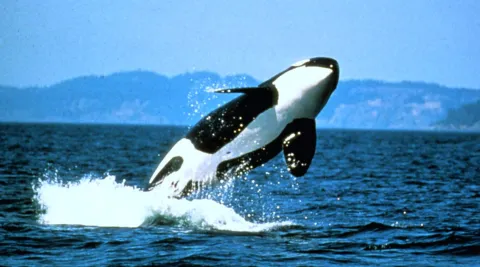
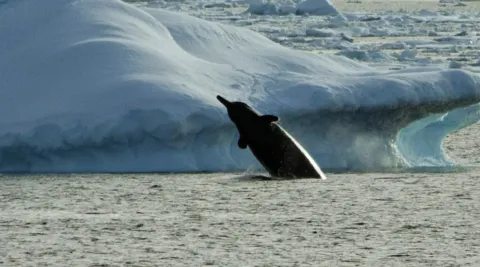
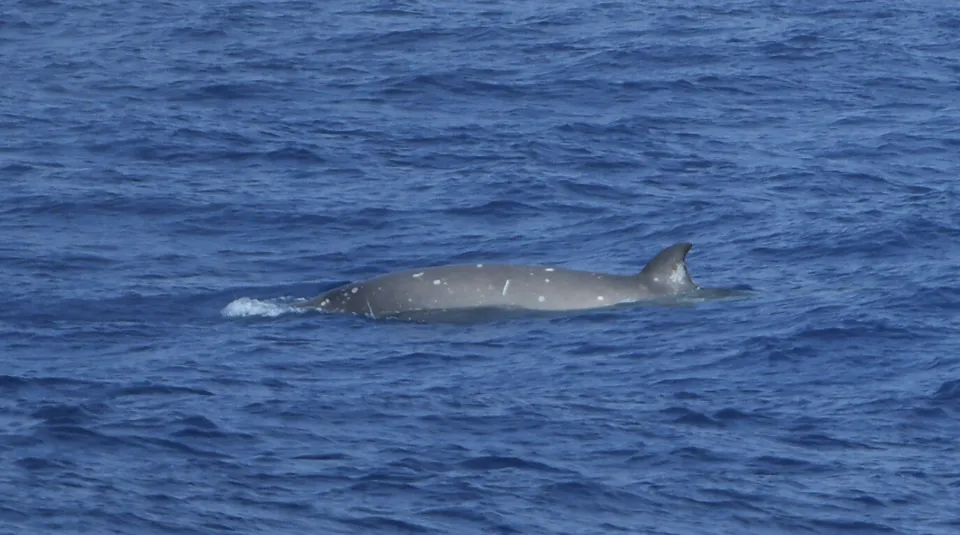
Accounting for the majority of beaked-whale encounters south of the Antarctic Convergence, the 7.5-metre southern bottlenose whale has a steep, melon-shaped forehead rising sharply from a short dolphin-like beak — turning pale creamy white in mature males scarred by tooth rakes from rival bulls. Specialized squid hunters, they dive past 1,000 metres for up to an hour along submarine canyons.
Bridge lookouts spot their low, bushy, slightly forward-angled blows in deep shelf-break waters of the southern Drake Passage, Bransfield Strait, Scotia Sea, and Ross Sea, where curious pods of three to ten whales occasionally circle quiet expedition ships.
When to Spot Southern Bottlenose Whale (Oct–Mar)
Migratory baleen and toothed whales arrive in growing numbers from December, reaching peak krill-feeding density across February and March.
Frequently asked questions about Southern Bottlenose Whale
Browse all Antarctica expedition FAQsWhen is the best time to see Southern Bottlenose Whale in Antarctica?
Peak sighting months for Southern Bottlenose Whale are January, February, March. Migratory baleen and toothed whales arrive in growing numbers from December, reaching peak krill-feeding density across February and March. Read our Antarctic whale-watching month guide and seasonal comparison.
Where can you spot Southern Bottlenose Whale on an Antarctica cruise?
Southern Bottlenose Whale (Hyperoodon planifrons) is primarily encountered in Drake Passage, Antarctic Peninsula, Weddell Sea, Scotia Sea, Ross Sea, with 984 upcoming expedition departures visiting these habitats. Key field traits: diet of Deep-sea Antarctic squid & Patagonian toothfish; Diving & swimming: 1,000+ m · up to 60 min. Learn how daily Zodiac excursions and shore landings work.
How close can you approach Southern Bottlenose Whale under IAATO rules?
Under IAATO marine mammal guidelines, ships and Zodiacs slow to no-wake speed and idle or cut engines within 30–100 metres of Southern Bottlenose Whale, never encircling or cutting across their path — though curious whales frequently surface right beside stationary Zodiacs on their own. See our whale-watching FAQ.