| Scientific name | Thalassoica antarctica |
|---|---|
| Conservation status | LC Least Concern |
| Length & wingspan | 40–45 cm · 1.0–1.1 m |
| Weight | 500–770 g |
| Primary diet | Antarctic krill, lanternfish & glacial squid |
| Flight & range | Nests up to 250 km inland on nunataks |
| Did you know? | At Svarthamaren in Queen Maud Land, up to 200,000 pairs nest on bare mountain cliffs 200 km from open water — commuting hundreds of kilometres over the ice sheet to feed chicks. |
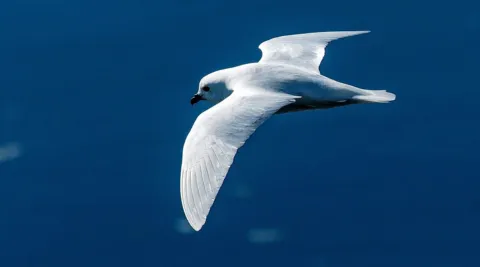
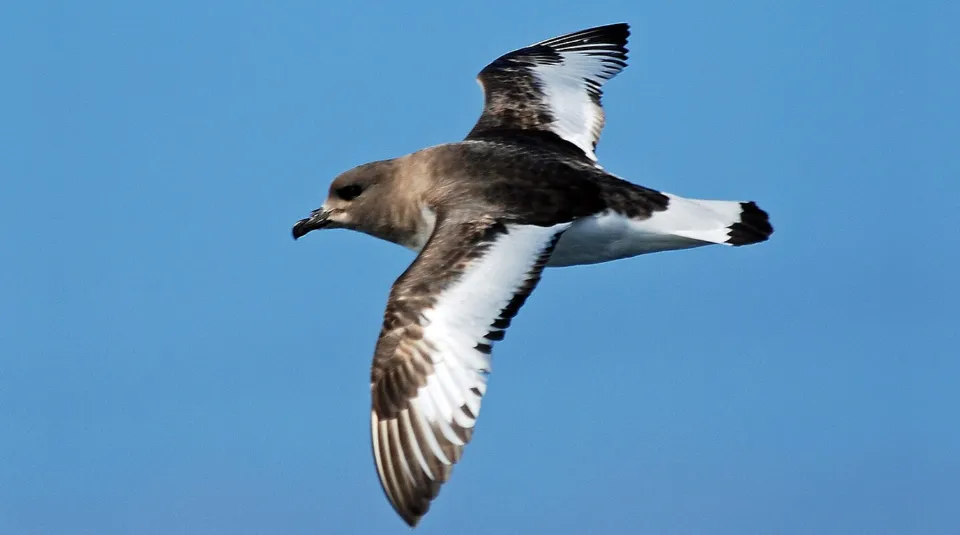
Unmistakable in flight, the Antarctic petrel looks dipped in dark espresso across head, mantle, and leading wing, contrasting sharply against broad pure-white trailing wing panels and a white-rimmed tail. Breeding strictly on ice-free nunataks and coastal cliffs of the Antarctic continent — sometimes hundreds of kilometres inland across glacial ice — it is a true high-polar specialist.
Encountering a tabular iceberg crowned by thousands of roosting Antarctic petrels in the Weddell Sea, Ross Sea, or south of the Antarctic Circle is one of the defining visual spectacles of deep-south expedition cruising.
When to Spot Antarctic Petrel (Oct–Mar)
Courtship and cliff nesting peak from November to January across the Drake Passage, Falkland Islands, South Georgia, and Peninsula headlands.
Frequently asked questions about Antarctic Petrel
Browse all Antarctica expedition FAQsWhen is the best time to see Antarctic Petrel in Antarctica?
Peak sighting months for Antarctic Petrel are November, December, January. Courtship and cliff nesting peak from November to January across the Drake Passage, Falkland Islands, South Georgia, and Peninsula headlands. Compare conditions in our Early, Peak & Late Summer FAQ.
Where can you spot Antarctic Petrel on an Antarctica cruise?
Antarctic Petrel (Thalassoica antarctica) is primarily encountered in Antarctic Peninsula, Antarctic Circle, Weddell Sea, Bellingshausen Sea, Ross Sea, with 912 upcoming expedition departures visiting these habitats. Key field traits: diet of Antarctic krill, lanternfish & glacial squid; Flight & range: Nests up to 250 km inland on nunataks. Learn how daily Zodiac excursions and shore landings work.
How close can you approach Antarctic Petrel under IAATO rules?
Under mandatory IAATO wildlife distance and biosecurity rules, visitors ashore must keep at least 5 metres (15 feet) from Antarctic Petrel, give birds the right of way on colony trails, and never kneel or place gear on the snow. If a curious penguin walks closer on its own, remain still and let it pass. See our recommended camera lenses (70–200mm / 100–400mm).