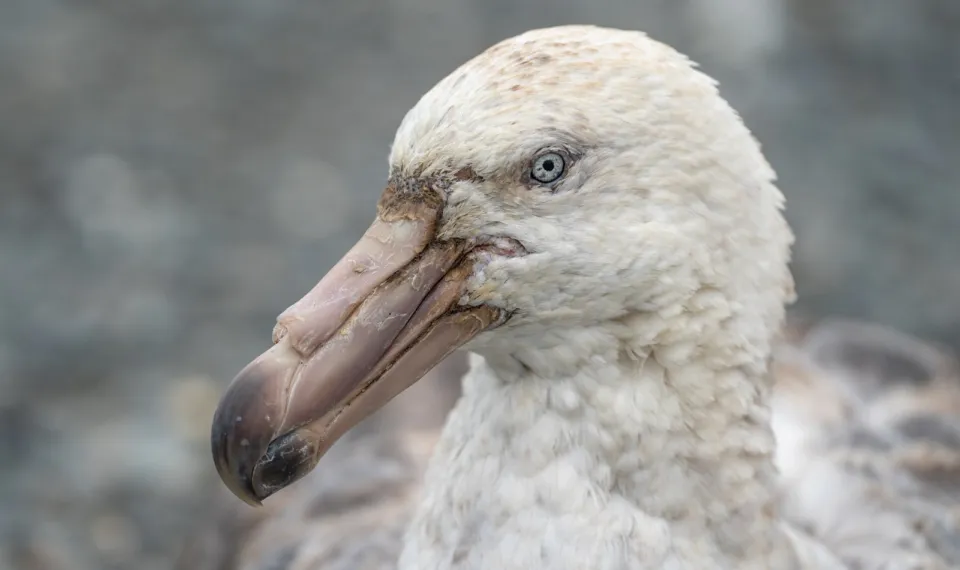
The southern giant petrel is one of the bulkier fliers you will see on a Southern Ocean voyage, a big, heavy-bodied bird that has picked up a string of nicknames over the years, among them Antarctic giant petrel, giant fulmar, stinker and stinkpot. It is a familiar shape trailing the wake of ships crossing the Drake Passage and cruising the channels of the Antarctic Peninsula, often the first large seabird spotted once land drops out of sight.
Its range overlaps broadly with that of the very similar northern giant petrel, though the southern bird's distribution sits slightly further south overall, which is exactly the latitude most expedition routes travel through. At sea the two species are easy to confuse, and the only reliable way to separate them is the bill-tip: greenish on the southern giant petrel, reddish on its northern relative, a detail worth a closer look through binoculars whenever one banks in close to the ship.
Beyond the open water crossings, giant petrels turn up reliably around the coastlines of South Georgia and the Falkland Islands, where the same broad, stiff-winged silhouette can be picked out gliding low over beaches and headlands. Travellers on austral summer departures should expect this to be one of the more constant seabird sightings of the trip, rather than a rare highlight.