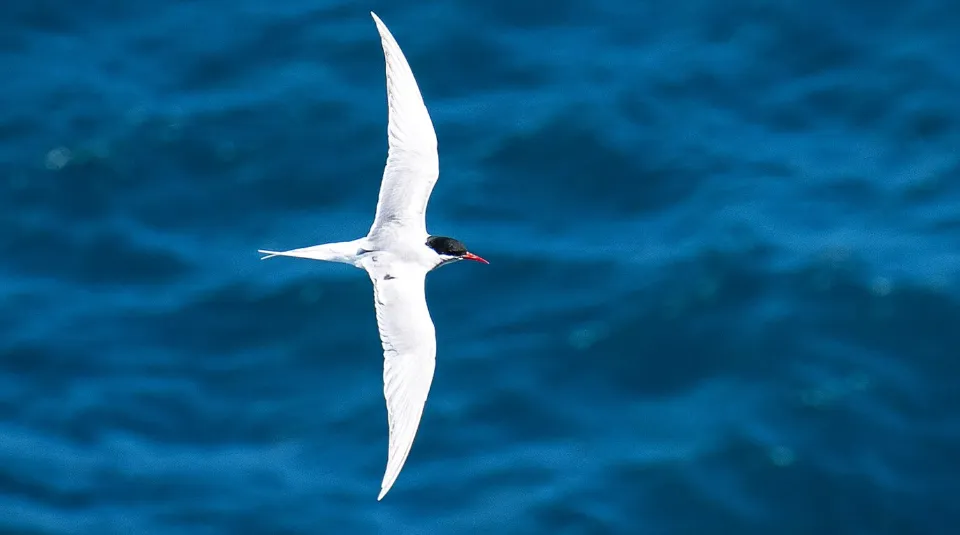
| Scientific name | Sterna vittata |
|---|---|
| Conservation status | LC Least Concern |
| Length & wingspan | 35–40 cm · 74–79 cm |
| Weight | 115–205 g |
| Primary diet | Krill, amphipods & juvenile icefish |
| Flight & range | Resident summer breeder south to 68°S |
| Did you know? | Unlike migrant Arctic terns that stay silent in non-breeding plumage while moulting on pack ice, Antarctic terns wear full black caps and blood-red bills right through the austral summer. |
Unlike the Arctic tern — which migrates from the high north solely to moult silently along the pack-ice edge in non-breeding plumage — the Antarctic tern breeds right through the austral summer on gravel moraines and rocky islets of the Antarctic Peninsula, South Shetlands, and sub-Antarctic islands. Breeding adults sport a jet-black cap underlined by a clean white cheek stripe, smoky grey underparts, and a vivid coral-red bill and legs.
Hovering gracefully over glacial meltwater plumes and shallow brash ice on Zodiac cruises, pairs plunge-dive for krill and juvenile icefish just metres from shore landings.
When to Spot Antarctic Tern (Oct–Mar)
Courtship and cliff nesting peak from November to January across the Drake Passage, Falkland Islands, South Georgia, and Peninsula headlands.
Frequently asked questions about Antarctic Tern
Browse all Antarctica expedition FAQsWhen is the best time to see Antarctic Tern in Antarctica?
Peak sighting months for Antarctic Tern are November, December, January. Courtship and cliff nesting peak from November to January across the Drake Passage, Falkland Islands, South Georgia, and Peninsula headlands. Compare conditions in our Early, Peak & Late Summer FAQ.
Where can you spot Antarctic Tern on an Antarctica cruise?
Antarctic Tern (Sterna vittata) is primarily encountered in Antarctic Peninsula, South Shetland Islands, Lemaire Channel, Gerlache Strait, South Georgia, with 986 upcoming expedition departures visiting these habitats. Key field traits: diet of Krill, amphipods & juvenile icefish; Flight & range: Resident summer breeder south to 68°S. Learn how daily Zodiac excursions and shore landings work.
How close can you approach Antarctic Tern under IAATO rules?
Under mandatory IAATO wildlife distance and biosecurity rules, visitors ashore must keep at least 5 metres (15 feet) from Antarctic Tern, give birds the right of way on colony trails, and never kneel or place gear on the snow. If a curious penguin walks closer on its own, remain still and let it pass. See our recommended camera lenses (70–200mm / 100–400mm).