| Scientific name | Halobaena caerulea |
|---|---|
| Conservation status | LC Least Concern |
| Length & wingspan | 26–32 cm · 62–71 cm |
| Weight | 160–230 g |
| Primary diet | Krill, amphipods, myctophids & small squid |
| Flight & range | Shallow plunge-dives to 6 m |
| Did you know? | Like storm petrels and albatrosses, nocturnal-burrowing blue petrels find their exact underground nest hole among thousands in pitch darkness strictly by an acute sense of smell. |
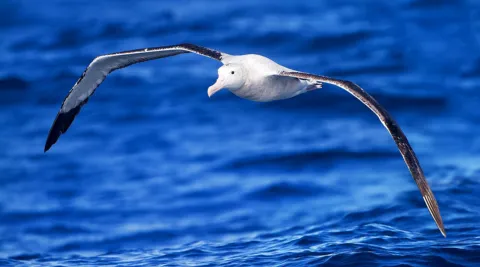
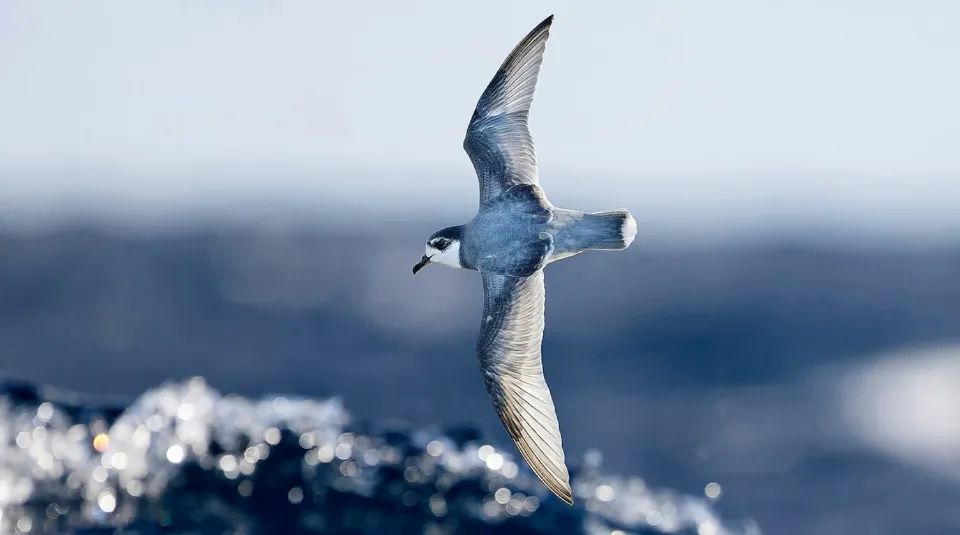
At first glance across whitecaps in the Drake Passage, the blue petrel resembles the swirling flocks of prions with which it often mingles: frosty blue-grey above with a bold dark “M” pattern spanning open wings. Look to the tail and head for the clincher — blue petrels wear a neat dark cap framing a white forehead and a crisp white terminal band across the tip of a dark tail (prions show a black tail tip).
Breeding in dense burrows around Cape Horn’s outer islands, South Georgia, and Macquarie Island, they zip low across wave crests throughout crossings of the Polar Front.
When to Spot Blue Petrel (Oct–Mar)
Courtship and cliff nesting peak from November to January across the Drake Passage, Falkland Islands, South Georgia, and Peninsula headlands.
Frequently asked questions about Blue Petrel
Browse all Antarctica expedition FAQsWhen is the best time to see Blue Petrel in Antarctica?
Peak sighting months for Blue Petrel are November, December, January. Courtship and cliff nesting peak from November to January across the Drake Passage, Falkland Islands, South Georgia, and Peninsula headlands. Compare conditions in our Early, Peak & Late Summer FAQ.
Where can you spot Blue Petrel on an Antarctica cruise?
Blue Petrel (Halobaena caerulea) is primarily encountered in Drake Passage, Cape Horn, Scotia Sea, South Georgia, Macquarie Island, with 958 upcoming expedition departures visiting these habitats. Key field traits: diet of Krill, amphipods, myctophids & small squid; Flight & range: Shallow plunge-dives to 6 m. Learn how daily Zodiac excursions and shore landings work.
How close can you approach Blue Petrel under IAATO rules?
Under mandatory IAATO wildlife distance and biosecurity rules, visitors ashore must keep at least 5 metres (15 feet) from Blue Petrel, give birds the right of way on colony trails, and never kneel or place gear on the snow. If a curious penguin walks closer on its own, remain still and let it pass. See our recommended camera lenses (70–200mm / 100–400mm).