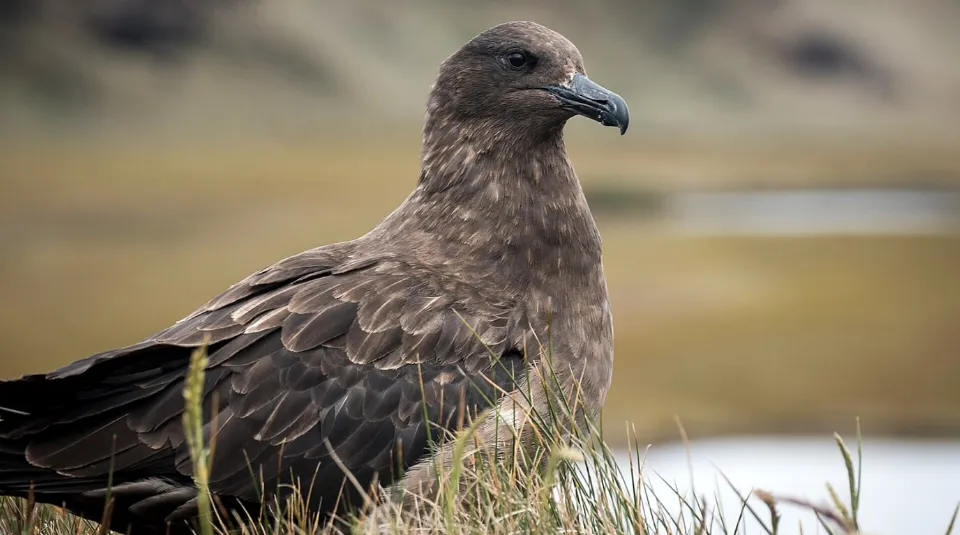
| Scientific name | Stercorarius antarcticus |
|---|---|
| Conservation status | LC Least Concern |
| Length & wingspan | 52–64 cm · 1.26–1.60 m |
| Weight | 1.2–2.1 kg |
| Primary diet | Penguin eggs & chicks, burrowing petrels, fish & carrion |
| Flight & range | Cooperative pair hunting & kleptoparasitism |
| Did you know? | Breeding pairs often hunt as a coordinated tag-team — one skua distracts an incubating penguin at the front of the nest while its partner darts in from behind to snatch an egg. |
You'll meet the brown skua on land as often as at sea: patrolling penguin rookeries in South Georgia, loitering around sheep paddocks and colonies in the Falkland Islands, or shadowing zodiac landings on the Antarctic Peninsula. It's a bird that breeds through the subantarctic and Antarctic zones and then pushes north once the season ends, so sightings on a typical austral-summer voyage are less about luck and more about simply being where it lives.
Taxonomists have never quite settled what to call it. Depending on which authority you follow, the brown skua is either a single wide-ranging species or splits into the Falkland skua, Tristan skua, and subantarctic skua — and matters get murkier still because it hybridises with both the south polar skua and the Chilean skua where their ranges overlap. Some researchers even treat the whole group as a southern outpost of the great skua, a bird otherwise confined to the Northern Hemisphere. None of this affects what you'll see on deck: a large, dark, thickset skua working the tideline or colony edge, unbothered by an audience.
Across the Scotia Sea crossing between these landing sites, it's often the first seabird to reappear once the ship nears land again, a useful reminder that a coastline — and something to scavenge from it — is close.
When to Spot Brown Skua (Oct–Mar)
Courtship and cliff nesting peak from November to January across the Drake Passage, Falkland Islands, South Georgia, and Peninsula headlands.
Frequently asked questions about Brown Skua
Browse all Antarctica expedition FAQsWhen is the best time to see Brown Skua in Antarctica?
Peak sighting months for Brown Skua are November, December, January. Courtship and cliff nesting peak from November to January across the Drake Passage, Falkland Islands, South Georgia, and Peninsula headlands. Compare conditions in our Early, Peak & Late Summer FAQ.
Where can you spot Brown Skua on an Antarctica cruise?
Brown Skua (Stercorarius antarcticus) is primarily encountered in Antarctic Peninsula, South Shetland Islands, South Georgia, Falkland Islands, Macquarie Island, with 938 upcoming expedition departures visiting these habitats. Key field traits: diet of Penguin eggs & chicks, burrowing petrels, fish & carrion; Flight & range: Cooperative pair hunting & kleptoparasitism. Learn how daily Zodiac excursions and shore landings work.
How close can you approach Brown Skua under IAATO rules?
Under mandatory IAATO wildlife distance and biosecurity rules, visitors ashore must keep at least 5 metres (15 feet) from Brown Skua, give birds the right of way on colony trails, and never kneel or place gear on the snow. If a curious penguin walks closer on its own, remain still and let it pass. See our recommended camera lenses (70–200mm / 100–400mm).