| Scientific name | Phalcoboenus australis |
|---|---|
| Conservation status | NT Near Threatened |
| Length & wingspan | 53–65 cm · 1.16–1.25 m |
| Weight | 1.1–1.6 kg |
| Primary diet | Seabird eggs & chicks, carrion, beetles & kelp invertebrates |
| Polar adaptation | Southernmost bird of prey · ~1,500–4,000 individuals |
| Did you know? | Ranked alongside keas and crows for problem-solving intelligence, “Johnny Rooks” stole compasses and hats from Charles Darwin’s HMS Beagle crew in 1833 and still unzip unattended backpacks on Falkland beaches. |
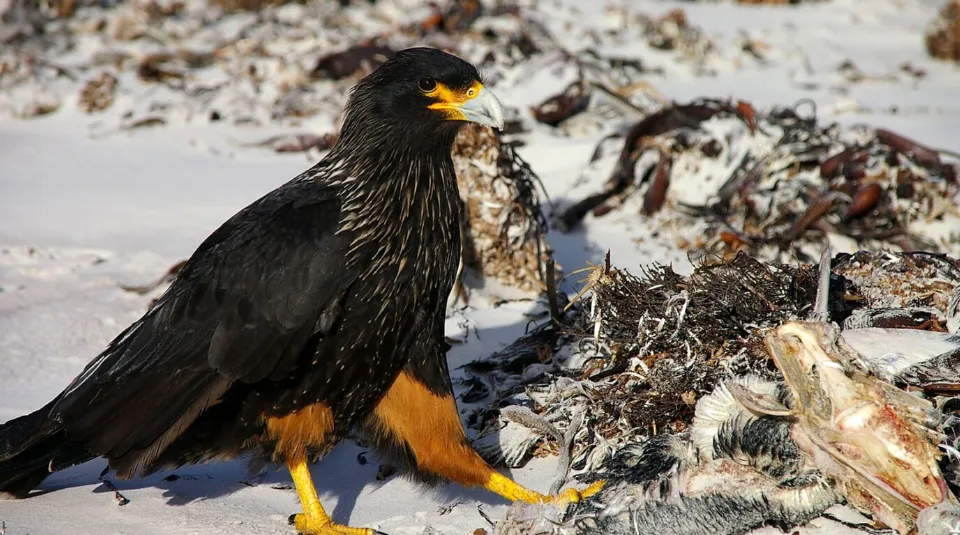
Few birds of prey are as tied to a single archipelago as the striated caracara, and the Falkland Islands are where most expedition travellers get their look at it. Landings on the outer islands, away from the two main settlements, tend to produce the closest and most curious encounters — this is a bird with a reputation for walking straight up to visitors rather than fleeing.
Islanders know it as the Johnny rook, a name most likely borrowed from the Johnny penguin, their local term for the gentoo. That naming quirk is a small but telling sign of how entangled the caracara's life is with the seabird colonies it shares the coastline with.
Globally the species is classed as Near Threatened, and its known range is narrow: Tierra del Fuego and the Falklands, nowhere else. Seeing one here is not a guaranteed checklist item so much as a genuine wildlife encounter specific to this corner of the South Atlantic.
When to Spot Striated Caracara (Oct–Mar)
Courtship and cliff nesting peak from November to January across the Drake Passage, Falkland Islands, South Georgia, and Peninsula headlands.
Frequently asked questions about Striated Caracara
Browse all Antarctica expedition FAQsWhen is the best time to see Striated Caracara in Antarctica?
Peak sighting months for Striated Caracara are November, December, January. Courtship and cliff nesting peak from November to January across the Drake Passage, Falkland Islands, South Georgia, and Peninsula headlands. Compare conditions in our Early, Peak & Late Summer FAQ.
Where can you spot Striated Caracara on an Antarctica cruise?
Striated Caracara (Phalcoboenus australis) is primarily encountered in Beagle Channel, Tierra del Fuego, Cape Horn, Falkland Islands, with 548 upcoming expedition departures visiting these habitats. Key field traits: diet of Seabird eggs & chicks, carrion, beetles & kelp invertebrates; Polar adaptation: Southernmost bird of prey · ~1,500–4,000 individuals. Learn how daily Zodiac excursions and shore landings work.
How close can you approach Striated Caracara under IAATO rules?
Under mandatory IAATO wildlife distance and biosecurity rules, visitors ashore must keep at least 5 metres (15 feet) from Striated Caracara, give birds the right of way on colony trails, and never kneel or place gear on the snow. If a curious penguin walks closer on its own, remain still and let it pass. See our recommended camera lenses (70–200mm / 100–400mm).