| Scientific name | Anas flavirostris |
|---|---|
| Conservation status | LC Least Concern |
| Length & wingspan | 35–44 cm · 62–70 cm |
| Weight | 360–460 g |
| Primary diet | Aquatic insect larvae, fairy shrimp, seeds & pond algae |
| Polar adaptation | Natural 1,300+ km open-ocean colonizer of South Georgia |
| Did you know? | Unaided by humans, pioneering flocks crossed over 1,300 km of stormy Scotia Sea to establish a wild breeding outpost in South Georgia’s Cumberland East Bay — first discovered by scientists in 1971. |
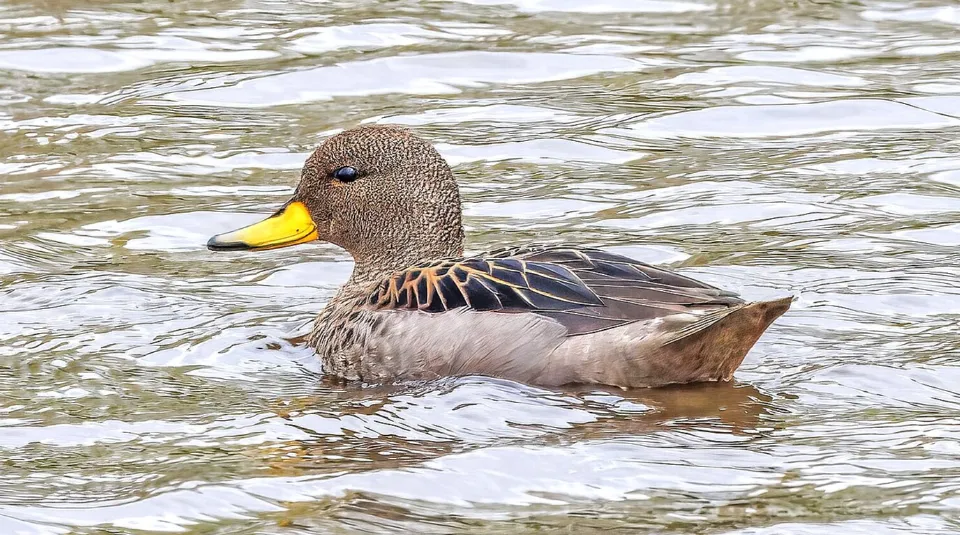
Smallest dabbling duck of the sub-Antarctic and southern cone, the yellow-billed (speckled) teal shows dark-scalloped buff plumage, a bright lemon-yellow bill bisected by a dark culmen, and an iridescent emerald-and-buff wing speculum in flight. First confirmed breeding around Cumberland East Bay on South Georgia in 1971 after self-colonizing across the Scotia Sea from the Falklands or Tierra del Fuego, it remains one of South Georgia’s 30 resident breeding birds.
Keen birders check sheltered freshwater tarns around Grytviken, Maiviken, and Falkland coastal ponds to separate compact, darker-headed yellow-billed teal from slightly larger, longer-tailed South Georgia pintails.
When to Spot Yellow-Billed Teal (Oct–Mar)
Courtship and cliff nesting peak from November to January across the Drake Passage, Falkland Islands, South Georgia, and Peninsula headlands.
Frequently asked questions about Yellow-Billed Teal
Browse all Antarctica expedition FAQsWhen is the best time to see Yellow-Billed Teal in Antarctica?
Peak sighting months for Yellow-Billed Teal are November, December, January. Courtship and cliff nesting peak from November to January across the Drake Passage, Falkland Islands, South Georgia, and Peninsula headlands. Compare conditions in our Early, Peak & Late Summer FAQ.
Where can you spot Yellow-Billed Teal on an Antarctica cruise?
Yellow-Billed Teal (Anas flavirostris) is primarily encountered in Beagle Channel, Tierra del Fuego, Patagonia, South Georgia, Falkland Islands, with 722 upcoming expedition departures visiting these habitats. Key field traits: diet of Aquatic insect larvae, fairy shrimp, seeds & pond algae; Polar adaptation: Natural 1,300+ km open-ocean colonizer of South Georgia. Learn how daily Zodiac excursions and shore landings work.
How close can you approach Yellow-Billed Teal under IAATO rules?
Under mandatory IAATO wildlife distance and biosecurity rules, visitors ashore must keep at least 5 metres (15 feet) from Yellow-Billed Teal, give birds the right of way on colony trails, and never kneel or place gear on the snow. If a curious penguin walks closer on its own, remain still and let it pass. See our recommended camera lenses (70–200mm / 100–400mm).