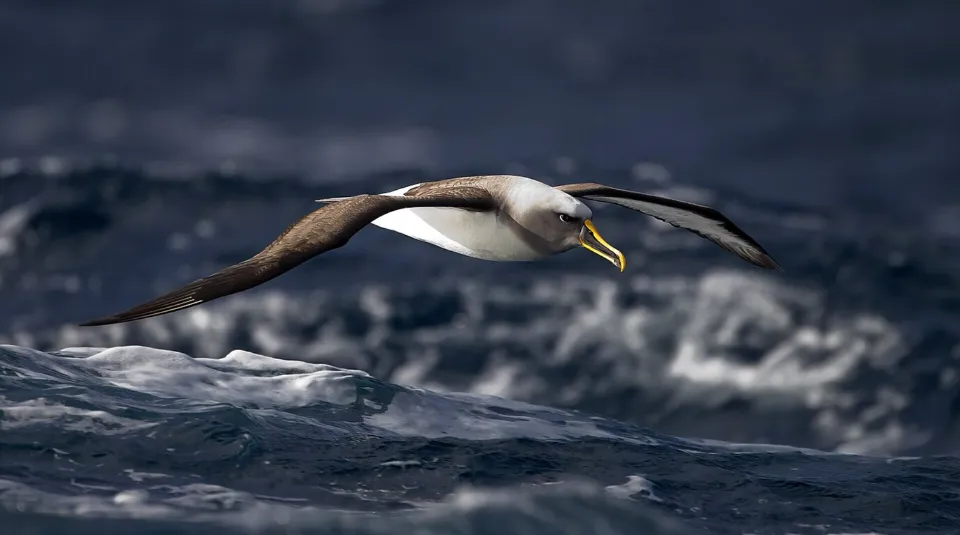
| Scientific name | Thalassarche bulleri |
|---|---|
| Conservation status | NT Near Threatened |
| Length & wingspan | 76–81 cm · 2.0–2.1 m |
| Weight | 2.5–3.8 kg |
| Primary diet | Squid, tunicates, fish & pelagic crustaceans |
| Flight & range | 10,000 km trans-Pacific foraging flights |
| Did you know? | Unusually for albatrosses, many Buller’s pairs nest beneath dense coastal shrub and forest canopy on the Snares and Solander Islands, walking narrow tunnel paths out to cliff launchpads. |
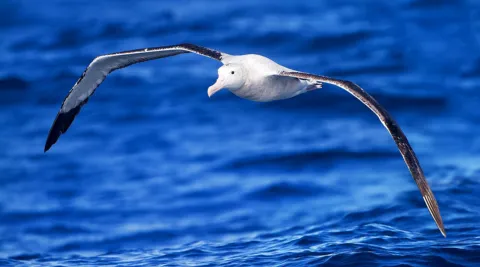
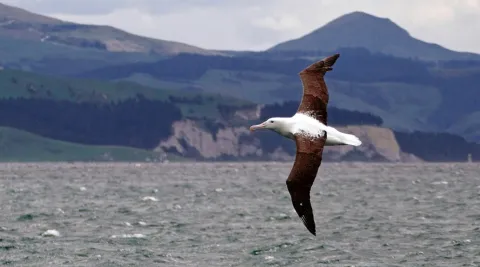
Often called one of the most handsome small albatrosses (mollymawks), Buller’s albatross combines a pearly silver-grey forehead and crown with smoky cheeks and a sleek black bill neatly piped top and bottom in bright canary yellow. Clean black margins frame the white underwing like ink brushwork.
Common in the wake of Ross Sea expeditions departing southern New Zealand past the Snares and Auckland Islands, wide-ranging adults also ride the Humboldt Current up the Chilean coast to waters west of Cape Horn.
When to Spot Buller's Albatross (Oct–Mar)
Courtship and cliff nesting peak from November to January across the Drake Passage, Falkland Islands, South Georgia, and Peninsula headlands.
Frequently asked questions about Buller's Albatross
Browse all Antarctica expedition FAQsWhen is the best time to see Buller's Albatross in Antarctica?
Peak sighting months for Buller's Albatross are November, December, January. Courtship and cliff nesting peak from November to January across the Drake Passage, Falkland Islands, South Georgia, and Peninsula headlands. Compare conditions in our Early, Peak & Late Summer FAQ.
Where can you spot Buller's Albatross on an Antarctica cruise?
Buller's Albatross (Thalassarche bulleri) is primarily encountered in Cape Horn, Auckland Islands, Campbell Island, with 170 upcoming expedition departures visiting these habitats. Key field traits: diet of Squid, tunicates, fish & pelagic crustaceans; Flight & range: 10,000 km trans-Pacific foraging flights. Learn how daily Zodiac excursions and shore landings work.
How close can you approach Buller's Albatross under IAATO rules?
Under mandatory IAATO wildlife distance and biosecurity rules, visitors ashore must keep at least 5 metres (15 feet) from Buller's Albatross, give birds the right of way on colony trails, and never kneel or place gear on the snow. If a curious penguin walks closer on its own, remain still and let it pass. See our recommended camera lenses (70–200mm / 100–400mm).