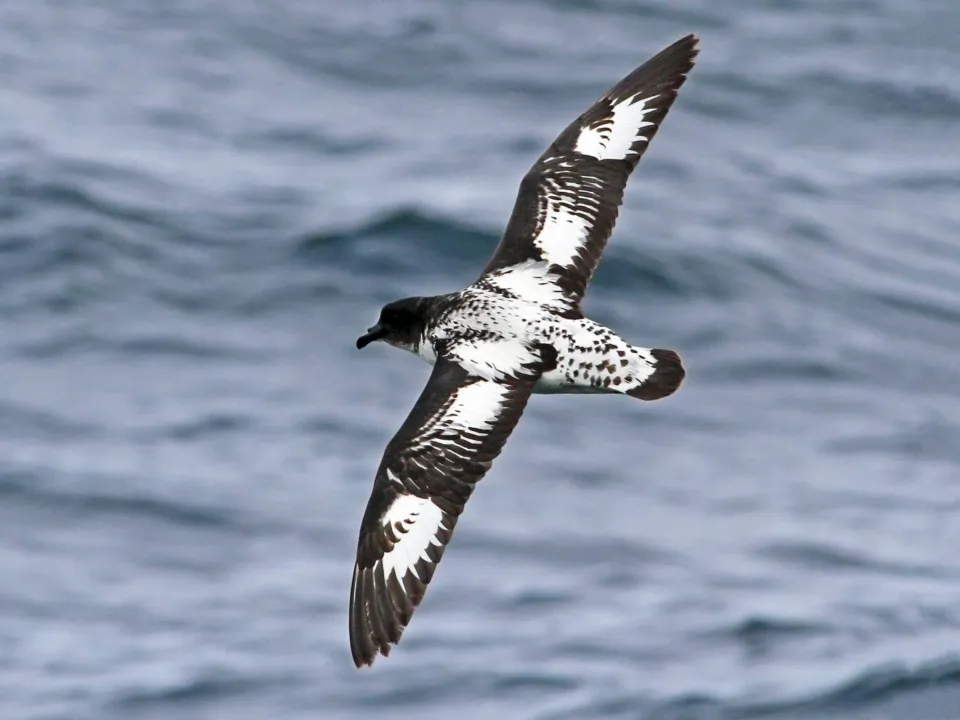
The Cape petrel, or pintado petrel (Daption capense), belongs to the same family as the albatrosses and shearwaters, the Procellariidae, and is the only species in its genus, Daption. Taxonomically it sits close to the fulmarine petrels and the giant petrels, and like its relatives it is a confident flier that seems entirely at home in rough southern seas.
It is one of the seabirds most reliably seen on a crossing of the Drake Passage, where it often shadows the ship's wake for hours at a stretch, and it turns up just as readily over the open water of the Scotia Sea and along the shores of the Antarctic Peninsula and South Georgia. On most expedition itineraries, which run through the austral summer, it is one of the few birds you can expect on almost any leg of the voyage rather than at a single landing site.
With a total population estimated at roughly two million birds, the Cape petrel is genuinely common rather than a rare sighting, but that abundance does not make it any less satisfying to watch: small groups wheel and dip low over the swell, breaking off from the ship only to regroup a few minutes later.