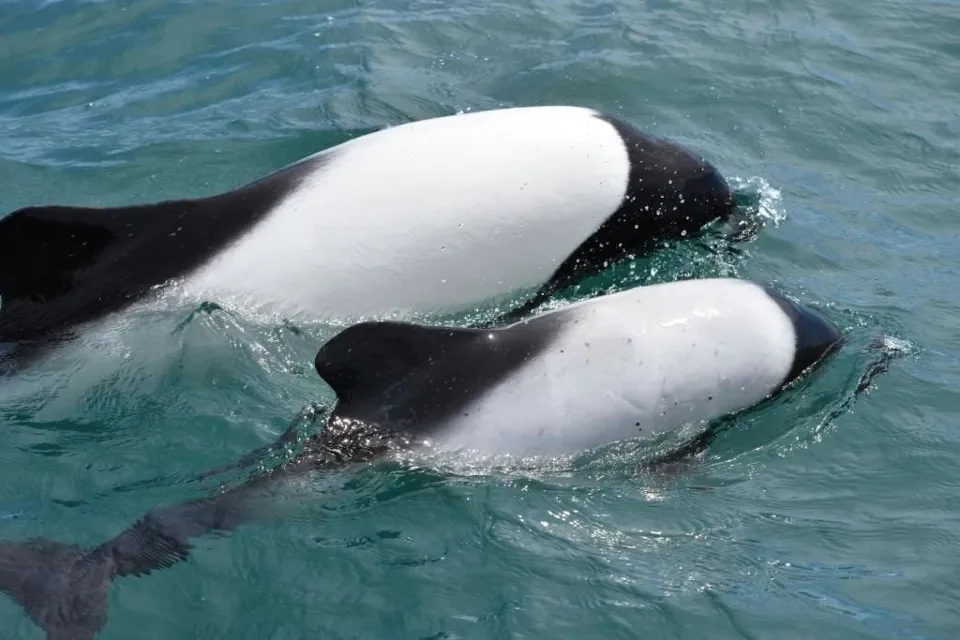
Commerson's dolphin is one of the smaller oceanic dolphins, and the subspecies found on these routes, C. c. commersonii, has a sharply-delineated black-and-white pattern quite different from the greyer, larger form that lives around the Kerguelen Islands on the other side of the world. Travellers most reliably meet it in the Beagle Channel, where small groups peel off from the shoreline to surf the wake of the ship, rolling and flashing their white flanks close enough to photograph without a long lens.
It turns up elsewhere along the same general stretch of coast — around the Falkland Islands, in the sheltered waters off Tierra del Fuego, and along parts of the Patagonian coastline further north, wherever ships thread through narrow channels and tidal races. The species is genuinely local to this end of South America, which is part of what makes a sighting feel like a marker that you've reached the far south rather than just another dolphin encounter.
The name commemorates Philibert Commerson, the French naturalist who first described the species in 1767 after seeing it in the Strait of Magellan, and the animal has picked up a string of nicknames since — jacobita, skunk dolphin, piebald dolphin, panda dolphin, tonina overa — all riffing on the same stark two-tone coat. On a Patagonia or Beagle Channel itinerary it's usually the smaller, quicker, more contrasty dolphin darting around the ship, easy to tell apart from anything larger cruising further offshore.