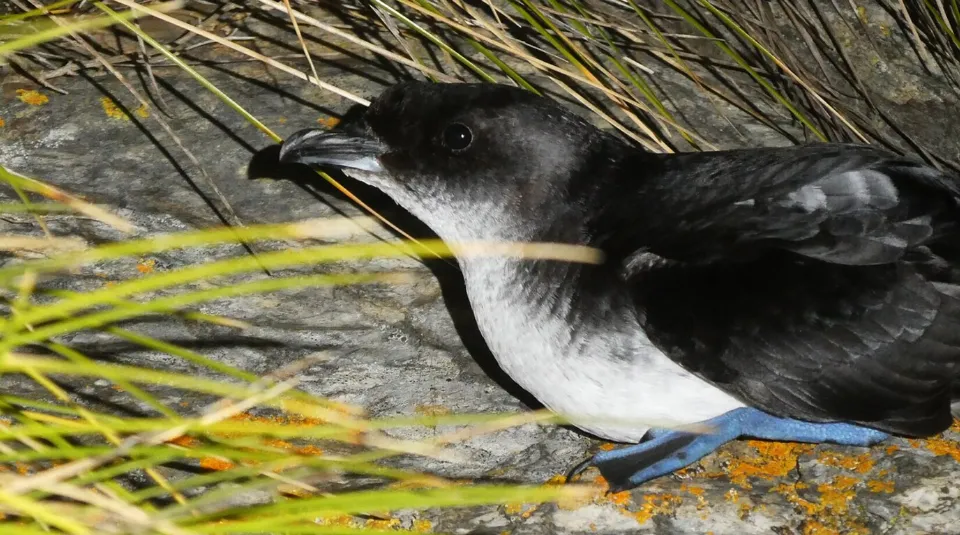
| Scientific name | Pelecanoides urinatrix |
|---|---|
| Conservation status | LC Least Concern |
| Length & wingspan | 20–25 cm · 33–38 cm |
| Weight | 110–160 g |
| Primary diet | Copepods, euphausiid krill & amphipods |
| Diving & swimming | Wing-propelled dives past 60 m |
| Did you know? | A textbook twin of Arctic little auks by convergent evolution, it flies straight into the face of breaking swells without pausing and carries food home in an expandable throat pouch. |
In a textbook case of convergent evolution, the stocky, stub-winged common diving petrel looks and behaves remarkably like the puffins and auklets of the Arctic. Whirring low over the sea on blur-fast wingbeats, it punches headfirst into the front of an oncoming wave and pops out flying on the far side — using those same compact wings to “fly” underwater after krill and copepods.
Encountered right from the Beagle Channel and Cape Horn out across the Falkland Islands, South Georgia, and sub-Antarctic New Zealand, they burst up around ship bows like clockwork toys.
When to Spot Common Diving Petrel (Oct–Mar)
Courtship and cliff nesting peak from November to January across the Drake Passage, Falkland Islands, South Georgia, and Peninsula headlands.
Frequently asked questions about Common Diving Petrel
Browse all Antarctica expedition FAQsWhen is the best time to see Common Diving Petrel in Antarctica?
Peak sighting months for Common Diving Petrel are November, December, January. Courtship and cliff nesting peak from November to January across the Drake Passage, Falkland Islands, South Georgia, and Peninsula headlands. Compare conditions in our Early, Peak & Late Summer FAQ.
Where can you spot Common Diving Petrel on an Antarctica cruise?
Common Diving Petrel (Pelecanoides urinatrix) is primarily encountered in Beagle Channel, Cape Horn, South Georgia, Falkland Islands, Auckland Islands, with 521 upcoming expedition departures visiting these habitats. Key field traits: diet of Copepods, euphausiid krill & amphipods; Diving & swimming: Wing-propelled dives past 60 m. Learn how daily Zodiac excursions and shore landings work.
How close can you approach Common Diving Petrel under IAATO rules?
Under mandatory IAATO wildlife distance and biosecurity rules, visitors ashore must keep at least 5 metres (15 feet) from Common Diving Petrel, give birds the right of way on colony trails, and never kneel or place gear on the snow. If a curious penguin walks closer on its own, remain still and let it pass. See our recommended camera lenses (70–200mm / 100–400mm).