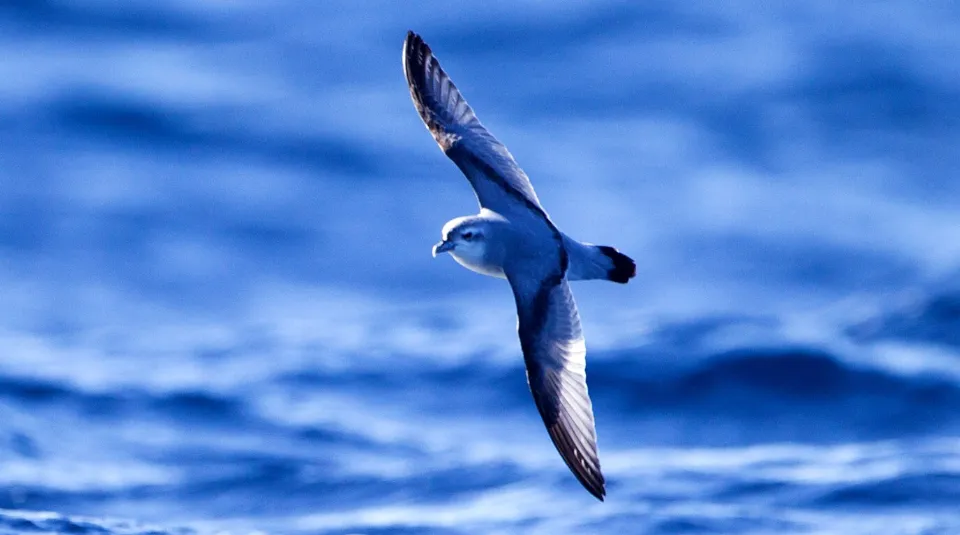
| Scientific name | Pachyptila turtur |
|---|---|
| Conservation status | LC Least Concern |
| Length & wingspan | 23–28 cm · 56–60 cm |
| Weight | 110–145 g |
| Primary diet | Planktonic copepods, krill & stalked barnacles |
| Flight & range | Smallest prion · nocturnal burrow colonies |
| Did you know? | To evade predatory skuas and gulls on sub-Antarctic islands, tens of thousands of fairy prions wait offshore until dusk before pouring onto coastal cliffs in swirling nocturnal blizzards. |
Smallest member of the prion genus, the fairy prion is a delicate powder-blue-grey seabird with a stubby bill, faint eyebrow, and a conspicuously broad black terminal band covering nearly half the upper tail — far wider than on Antarctic or slender-billed prions.
Nesting in rock crevices and tussac burrows on the Falkland Islands, South Georgia, Macquarie Island, and New Zealand’s sub-Antarctic islands, flocks dance right over breaking surf and swarm offshore convergence lines where tiny crustaceans concentrate.
When to Spot Fairy Prion (Oct–Mar)
Courtship and cliff nesting peak from November to January across the Drake Passage, Falkland Islands, South Georgia, and Peninsula headlands.
Frequently asked questions about Fairy Prion
Browse all Antarctica expedition FAQsWhen is the best time to see Fairy Prion in Antarctica?
Peak sighting months for Fairy Prion are November, December, January. Courtship and cliff nesting peak from November to January across the Drake Passage, Falkland Islands, South Georgia, and Peninsula headlands. Compare conditions in our Early, Peak & Late Summer FAQ.
Where can you spot Fairy Prion on an Antarctica cruise?
Fairy Prion (Pachyptila turtur) is primarily encountered in Scotia Sea, South Georgia, Falkland Islands, Macquarie Island, Auckland Islands, with 214 upcoming expedition departures visiting these habitats. Key field traits: diet of Planktonic copepods, krill & stalked barnacles; Flight & range: Smallest prion · nocturnal burrow colonies. Learn how daily Zodiac excursions and shore landings work.
How close can you approach Fairy Prion under IAATO rules?
Under mandatory IAATO wildlife distance and biosecurity rules, visitors ashore must keep at least 5 metres (15 feet) from Fairy Prion, give birds the right of way on colony trails, and never kneel or place gear on the snow. If a curious penguin walks closer on its own, remain still and let it pass. See our recommended camera lenses (70–200mm / 100–400mm).