| Scientific name | Pelecanoides georgicus |
|---|---|
| Conservation status | LC Least Concern |
| Length & wingspan | 18–22 cm · 30–33 cm |
| Weight | 90–150 g |
| Primary diet | Antarctic krill, copepods & amphipods |
| Diving & swimming | Dives to 48 m · burrows alpine scree above snowline |
| Did you know? | To coexist with millions of common diving petrels on the same island without competing for space, South Georgia diving petrels dig burrows in bare high-altitude mountain scree up to 6 km inland. |
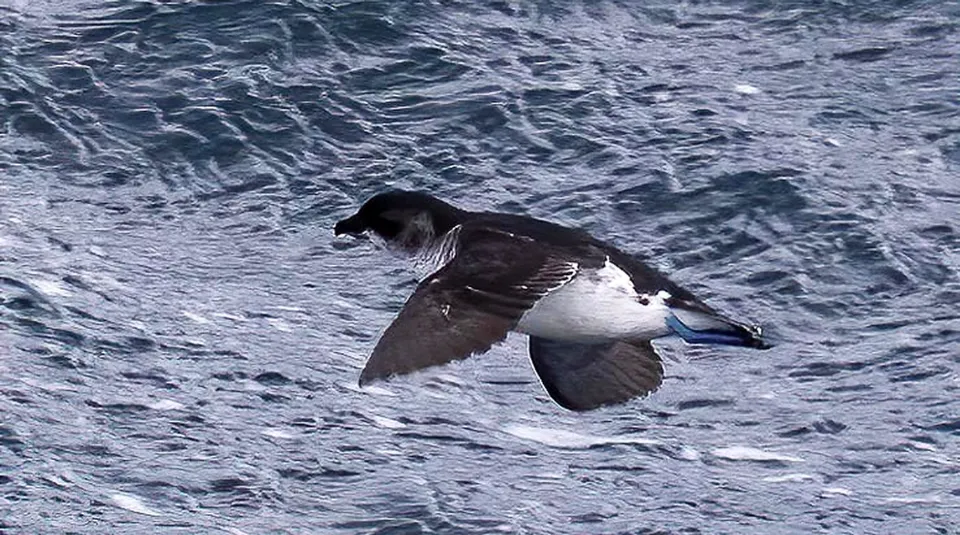
Closely resembling the common diving petrel at sea yet ecologically partitioned ashore, the South Georgia diving petrel avoids coastal tussac turf altogether to dig its nesting burrows high up bare alpine scree slopes above the snowline, sparing chicks from waterlogged peat. Closer views reveal paler silvery-white inner primary feathers and a cleaner white foreneck than its coastal cousin.
Roughly two million breeding pairs nest across South Georgia, pouring down from mountain screes after dusk and whirring across icy bays and offshore krill slicks throughout the Scotia Sea from November through March.
When to Spot South Georgia Diving Petrel (Oct–Mar)
Courtship and cliff nesting peak from November to January across the Drake Passage, Falkland Islands, South Georgia, and Peninsula headlands.
Frequently asked questions about South Georgia Diving Petrel
Browse all Antarctica expedition FAQsWhen is the best time to see South Georgia Diving Petrel in Antarctica?
Peak sighting months for South Georgia Diving Petrel are November, December, January. Courtship and cliff nesting peak from November to January across the Drake Passage, Falkland Islands, South Georgia, and Peninsula headlands. Compare conditions in our Early, Peak & Late Summer FAQ.
Where can you spot South Georgia Diving Petrel on an Antarctica cruise?
South Georgia Diving Petrel (Pelecanoides georgicus) is primarily encountered in Scotia Sea, South Georgia, Macquarie Island, Auckland Islands, with 205 upcoming expedition departures visiting these habitats. Key field traits: diet of Antarctic krill, copepods & amphipods; Diving & swimming: Dives to 48 m · burrows alpine scree above snowline. Learn how daily Zodiac excursions and shore landings work.
How close can you approach South Georgia Diving Petrel under IAATO rules?
Under mandatory IAATO wildlife distance and biosecurity rules, visitors ashore must keep at least 5 metres (15 feet) from South Georgia Diving Petrel, give birds the right of way on colony trails, and never kneel or place gear on the snow. If a curious penguin walks closer on its own, remain still and let it pass. See our recommended camera lenses (70–200mm / 100–400mm).