| Scientific name | Anthus antarcticus |
|---|---|
| Conservation status | LC Least Concern |
| Length & wingspan | 16.5 cm · 23–25 cm |
| Weight | 34–40 g |
| Primary diet | Spiders, kelp flies, beetles & intertidal amphipods |
| Polar adaptation | World’s southernmost songbird · non-migratory |
| Did you know? | Antarctica’s sole songbird south of the Polar Front survived 200 years of introduced brown rats on tiny offshore stacks — then triumphantly recolonized mainland South Georgia as soon as rats were eradicated in 2018. |
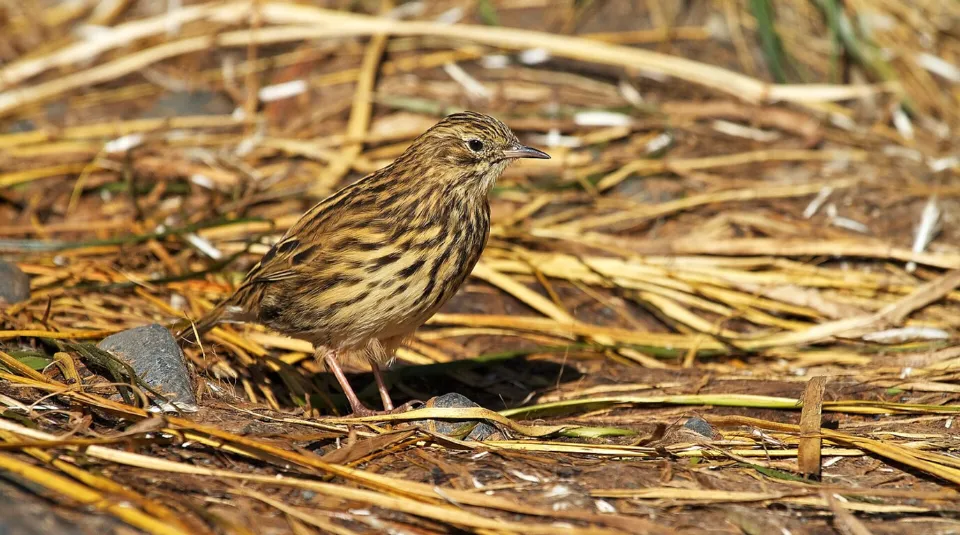
The world’s southernmost passerine and the only true songbird nesting inside the Antarctic Convergence, the streaked buff-and-brown South Georgia pipit was driven for two centuries onto tiny rat-free offshore islets after sealing vessels accidentally introduced brown rats. Following the world’s largest island habitat restoration project (declared rat-free in 2018), pipits immediately recolonised mainland South Georgia.
Hearing a songbird’s bright, cascading aerial display flight above glacier-ringed tussac slopes at Grytviken, Prion Island, or St Andrews Bay is one of modern polar conservation’s most moving experiences.
When to Spot South Georgia Pipit (Oct–Mar)
Courtship and cliff nesting peak from November to January across the Drake Passage, Falkland Islands, South Georgia, and Peninsula headlands.
Frequently asked questions about South Georgia Pipit
Browse all Antarctica expedition FAQsWhen is the best time to see South Georgia Pipit in Antarctica?
Peak sighting months for South Georgia Pipit are November, December, January. Courtship and cliff nesting peak from November to January across the Drake Passage, Falkland Islands, South Georgia, and Peninsula headlands. Compare conditions in our Early, Peak & Late Summer FAQ.
Where can you spot South Georgia Pipit on an Antarctica cruise?
South Georgia Pipit (Anthus antarcticus) is primarily encountered in South Georgia, with 148 upcoming expedition departures visiting these habitats. Key field traits: diet of Spiders, kelp flies, beetles & intertidal amphipods; Polar adaptation: World’s southernmost songbird · non-migratory. Learn how daily Zodiac excursions and shore landings work.
How close can you approach South Georgia Pipit under IAATO rules?
Under mandatory IAATO wildlife distance and biosecurity rules, visitors ashore must keep at least 5 metres (15 feet) from South Georgia Pipit, give birds the right of way on colony trails, and never kneel or place gear on the snow. If a curious penguin walks closer on its own, remain still and let it pass. See our recommended camera lenses (70–200mm / 100–400mm).