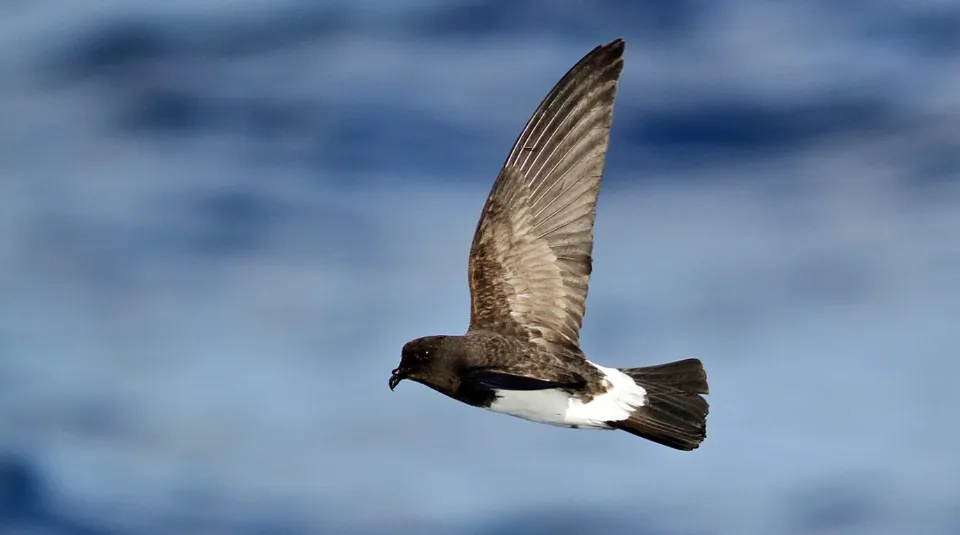
| Scientific name | Fregetta grallaria |
|---|---|
| Conservation status | LC Least Concern |
| Length & wingspan | 18–20 cm · 46–48 cm |
| Weight | 45–60 g |
| Primary diet | Small pelagic squid, myctophids & surface crustaceans |
| Flight & range | Long-legged wave-bouncer of cool South Atlantic fronts |
| Did you know? | Its species name grallaria means “stilt-walker” — kicking off steep ocean swells on long, spring-loaded legs, it glides sideways across wave crests without ever submerging. |
Closely allied to the black-bellied storm petrel and sharing its astonishing habit of “skiing” sideways off wave faces on one webbed foot, the white-bellied storm petrel lacks any dark central belly stripe — flashing an unbroken, gleaming white lower breast, belly, and underwing lining below a sharp dark hood.
Encountered primarily on northern Scotia Sea approaches to South Georgia and Atlantic Odyssey positioning voyages toward Tristan da Cunha, a clean view over deep ocean swell is a highlight on any polar birder’s checklist.
When to Spot White-Bellied Storm Petrel (Oct–Mar)
Courtship and cliff nesting peak from November to January across the Drake Passage, Falkland Islands, South Georgia, and Peninsula headlands.
Frequently asked questions about White-Bellied Storm Petrel
Browse all Antarctica expedition FAQsWhen is the best time to see White-Bellied Storm Petrel in Antarctica?
Peak sighting months for White-Bellied Storm Petrel are November, December, January. Courtship and cliff nesting peak from November to January across the Drake Passage, Falkland Islands, South Georgia, and Peninsula headlands. Compare conditions in our Early, Peak & Late Summer FAQ.
Where can you spot White-Bellied Storm Petrel on an Antarctica cruise?
White-Bellied Storm Petrel (Fregetta grallaria) is primarily encountered in Scotia Sea, South Georgia, with 196 upcoming expedition departures visiting these habitats. Key field traits: diet of Small pelagic squid, myctophids & surface crustaceans; Flight & range: Long-legged wave-bouncer of cool South Atlantic fronts. Learn how daily Zodiac excursions and shore landings work.
How close can you approach White-Bellied Storm Petrel under IAATO rules?
Under mandatory IAATO wildlife distance and biosecurity rules, visitors ashore must keep at least 5 metres (15 feet) from White-Bellied Storm Petrel, give birds the right of way on colony trails, and never kneel or place gear on the snow. If a curious penguin walks closer on its own, remain still and let it pass. See our recommended camera lenses (70–200mm / 100–400mm).