| Scientific name | Channichthyidae |
|---|---|
| Conservation status | LC Least Concern |
| Body length | 25–75 cm |
| Weight | 0.2–2.2 kg |
| Primary diet | Antarctic krill, mysids & small benthic fish |
| Polar adaptation | Zero hemoglobin · antifreeze blood |
| Did you know? | Crocodile icefishes are the only known vertebrates on Earth whose adults completely lack red blood cells and hemoglobin, pumping water-clear plasma with oversized hearts through −1.9 °C seas. |
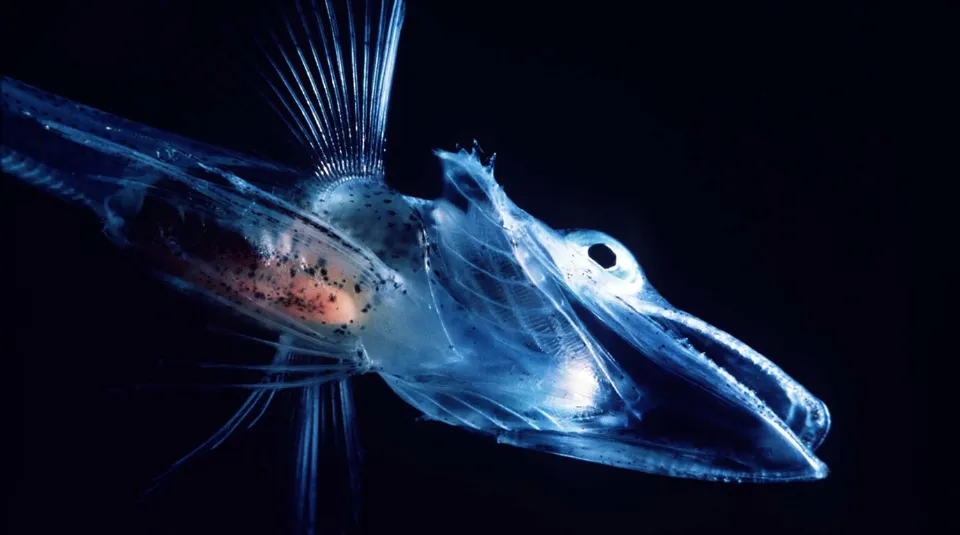
Crocodile icefishes (family Channichthyidae) represent one of evolutionary biology’s greatest marvels: they are the sole known vertebrates whose adults completely lack haemoglobin and red blood cells. Because frigid, storm-mixed Southern Ocean water holds nearly twice as much dissolved oxygen as tropical seas, icefishes survive with enlarged hearts pumping translucent, water-clear plasma through oversized blood vessels alongside antifreeze proteins.
Travellers on polar scuba dives, submarine excursions, or ROV camera deployments along the Antarctic Peninsula and South Georgia frequently spot big-jawed icefish resting motionless on sponge-draped seabeds, and shags regularly surface clutching silvery icefish in their bills near Zodiacs.
When to Spot Antarctic Icefish (Oct–Mar)
Southern Ocean summer daylight drives massive phytoplankton and krill blooms from December through February across polar upwelling zones.
Frequently asked questions about Antarctic Icefish
Browse all Antarctica expedition FAQsWhen is the best time to see Antarctic Icefish in Antarctica?
Peak sighting months for Antarctic Icefish are December, January, February. Southern Ocean summer daylight drives massive phytoplankton and krill blooms from December through February across polar upwelling zones. Compare conditions in our Early, Peak & Late Summer FAQ.
Where can you spot Antarctic Icefish on an Antarctica cruise?
Antarctic Icefish (Channichthyidae) is primarily encountered in Antarctic Peninsula, South Shetland Islands, South Georgia, South Orkney Islands, Ross Sea, with 933 upcoming expedition departures visiting these habitats. Key field traits: diet of Antarctic krill, mysids & small benthic fish; Polar adaptation: Zero hemoglobin · antifreeze blood. Learn how daily Zodiac excursions and shore landings work.
How close can you approach Antarctic Icefish under IAATO rules?
Under mandatory IAATO wildlife distance and biosecurity rules, visitors ashore must keep at least 5 metres (15 feet) from Antarctic Icefish, give birds the right of way on colony trails, and never kneel or place gear on the snow. If a curious penguin walks closer on its own, remain still and let it pass. See our recommended camera lenses (70–200mm / 100–400mm).