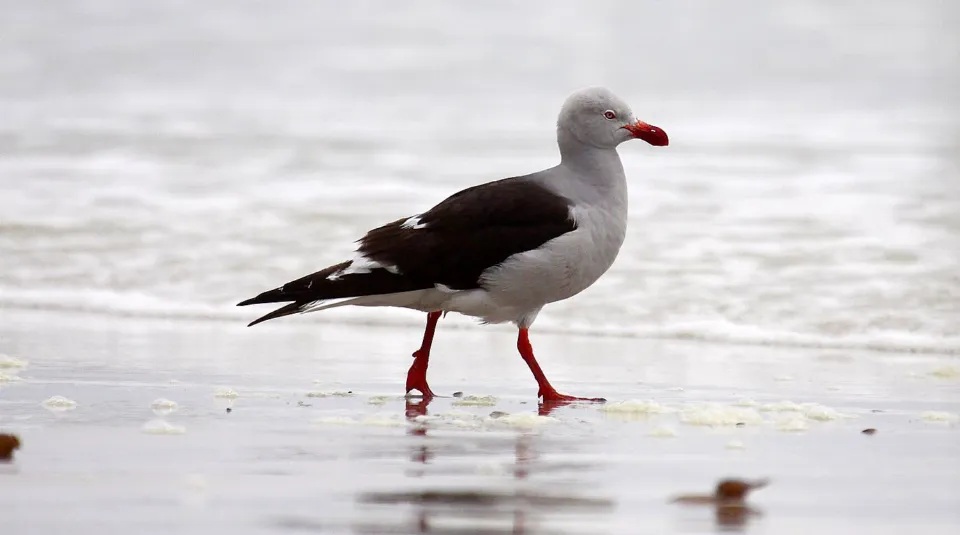
| Scientific name | Leucophaeus scoresbii |
|---|---|
| Conservation status | LC Least Concern |
| Length & wingspan | 40–46 cm · 1.04–1.10 m |
| Weight | 470–560 g |
| Primary diet | Mussels, marine invertebrates, seabird eggs & carrion |
| Polar adaptation | <20,000 birds globally · Patagonian endemic |
| Did you know? | Bold and opportunistic around Falkland penguin colonies, scarlet-billed dolphin gulls wait beside cormorants and penguins returning from sea to snatch dropped krill and fish scraps. |
Arguably one of the world’s handsomest gulls, the compact dolphin gull pairs a smooth dove-grey body and slate mantle with immaculate white wing trailing edges and a glowing scarlet-vermilion bill and legs. Restricted exclusively to southern Patagonia, Tierra del Fuego, and the Falkland Islands, its global population numbers fewer than 20,000 birds.
Every traveller boarding in Ushuaia can admire dolphin gulls right along the pier and Beagle Channel islands before meeting bustling nesting colonies alongside penguin rookeries in the Falkland Islands.
When to Spot Dolphin Gull (Oct–Mar)
Migratory baleen and toothed whales arrive in growing numbers from December, reaching peak krill-feeding density across February and March.
Frequently asked questions about Dolphin Gull
Browse all Antarctica expedition FAQsWhen is the best time to see Dolphin Gull in Antarctica?
Peak sighting months for Dolphin Gull are January, February, March. Migratory baleen and toothed whales arrive in growing numbers from December, reaching peak krill-feeding density across February and March. Read our Antarctic whale-watching month guide and seasonal comparison.
Where can you spot Dolphin Gull on an Antarctica cruise?
Dolphin Gull (Leucophaeus scoresbii) is primarily encountered in Beagle Channel, Tierra del Fuego, Patagonia, Cape Horn, Falkland Islands, with 704 upcoming expedition departures visiting these habitats. Key field traits: diet of Mussels, marine invertebrates, seabird eggs & carrion; Polar adaptation: <20,000 birds globally · Patagonian endemic. Learn how daily Zodiac excursions and shore landings work.
How close can you approach Dolphin Gull under IAATO rules?
Under IAATO marine mammal guidelines, ships and Zodiacs slow to no-wake speed and idle or cut engines within 30–100 metres of Dolphin Gull, never encircling or cutting across their path — though curious whales frequently surface right beside stationary Zodiacs on their own. See our whale-watching FAQ.