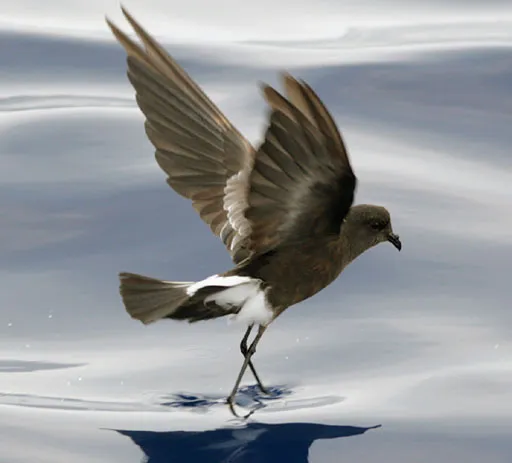
Few birds accompany a Southern Ocean crossing as faithfully as Wilson's storm petrel. Somewhere in the swells of the Drake Passage, a flock will usually appear off the stern, dancing across the water on stiff wings with legs dangling and feet pattering the surface — a feeding technique that makes them easy to pick out even for first-time birders.
They belong to the Oceanitidae, the austral storm petrel family, and turn up throughout the season wherever the ship goes, from the open water of the Drake to sheltered channels along the Antarctic Peninsula and the more exposed crossings of the Scotia Sea. Their circumpolar range and sheer numbers — current estimates put the world population at 8 to 20 million birds — mean sightings are less a matter of luck than of simply being on deck.
What's easy to miss is the scale of what you're looking at: this is one of the most abundant bird species on the planet, yet each individual weighs barely more than a few coins. The genus name Oceanites nods to the Oceanids of Greek myth, daughters of the sea, which feels apt for a bird that spends most of its life far from any shore.